

TL;DR:
- CIPD assessments require strict adherence to non-modifiable criteria and thorough internal moderation.
- Effective preparation, documentation, and internal quality assurance are essential for efficient, compliant reviews.
- Simplifying processes and focusing on key standards improve consistency and reduce risk of sanctions.
Assignment review bottlenecks are one of the most frustrating realities for CIPD training centres. A single missed criterion, a poorly documented moderation note, or an altered assessment task can trigger sanctions, null achievements, and a cascade of rework that costs everyone time. The pressure to stay compliant while processing submissions quickly is real, and the margin for error is narrow. This guide walks you through a structured, regulation-aligned process for reviewing CIPD assignments efficiently, covering everything from pre-review preparation to quality assurance and continuous improvement.
Table of Contents
- Understanding the CIPD assessment and review framework
- Preparing for an efficient assignment review
- Step-by-step CIPD assignment review process
- Quality assurance and verifying compliance
- Troubleshooting and continuous improvement
- A fresh perspective: why simplicity and compliance matter most
- Streamline your CIPD review with EduMark
- Frequently asked questions
Key Takeaways
| Point | Details |
|---|---|
| Comply with CIPD rules | Follow all CIPD-set criteria and never change assessment tasks to avoid sanctions. |
| Use efficient checklists | Prepare your documentation and moderation tools before reviewing assignments to save time. |
| Standardise quality assurance | Implement robust internal and external moderation for reliable, consistent outcomes. |
| Continuously improve processes | Address common pitfalls and refine your review approach using audit feedback for even better efficiency. |
Understanding the CIPD assessment and review framework
Before you can improve your review process, you need a firm grip on what the framework actually requires. CIPD qualifications use criterion-referenced assessment against specific learning outcomes set by CIPD, and results are strictly pass or fail. There are no grades, no partial credit, and no room for interpretation. Every single criterion must be met for a learner to pass.
This matters because it shapes the entire review mindset. Assessors are not ranking learners against each other. They are checking whether each piece of evidence satisfies each criterion. Understanding this distinction is the foundation of CIPD assessment standards compliance.
Here is how responsibilities are divided:
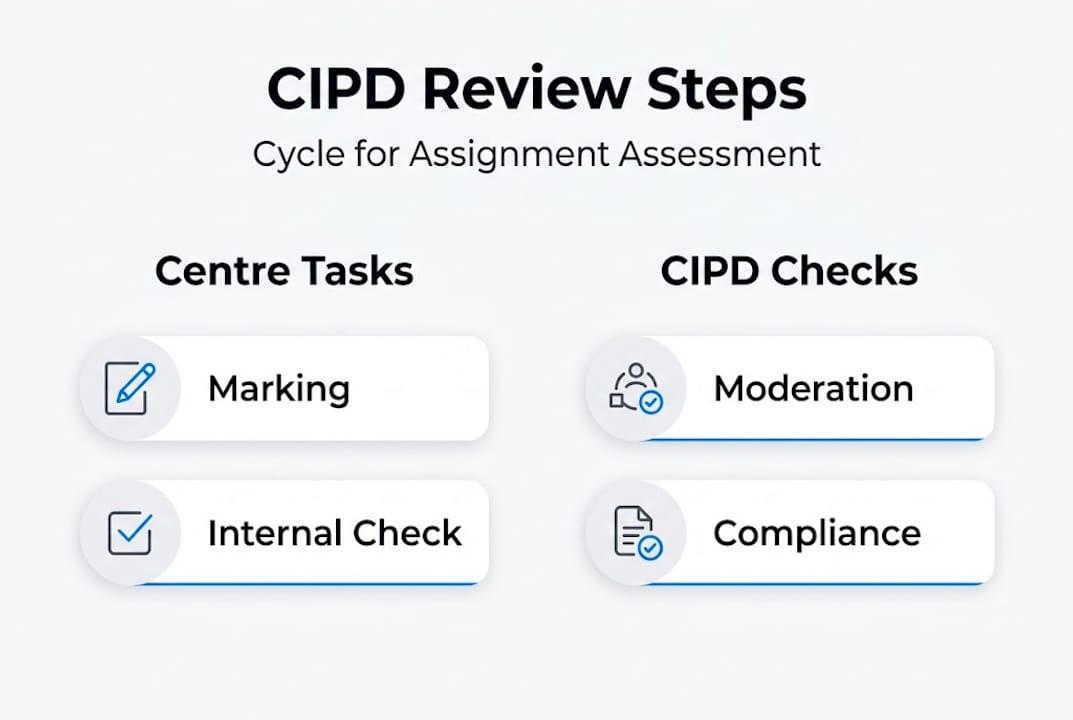
- Training centres are responsible for marking submissions and conducting internal moderation before results are submitted.
- CIPD performs external moderation sampling and validates centre marking before releasing results to learners.
- Assessors apply the criteria consistently and document their rationale clearly.
- Internal quality assurers check that assessors are applying criteria in a standardised way.
One of the most critical rules in the framework is that no alterations to assessments are permitted by centres. Changing tasks, prompts, or criteria, even with good intentions, leads to null achievements and formal sanctions. This is non-negotiable.
Regulatory note: Centres that modify CIPD assessment tasks, regardless of the reason, risk having all associated learner results nullified. Compliance here is binary, not a matter of degree.
New assessors frequently underestimate how tightly this framework is regulated. Familiarise yourself with assessment feedback compliance requirements early, and build them into your onboarding process for all new staff.
| Area | Centre responsibility | CIPD responsibility |
|---|---|---|
| Marking | Yes | No |
| Internal moderation | Yes | No |
| External moderation | No | Yes (sampling) |
| Result release | No | Yes |
| Criteria setting | No | Yes |
Preparing for an efficient assignment review
Efficiency starts before you open the first submission. Centres that rush into marking without proper preparation consistently encounter the same problems: missing documentation, inconsistent criteria application, and moderation portfolios that do not hold up to scrutiny.
As noted in the CIPD framework, centres mark and internally moderate all assessments before CIPD performs its external sampling. That means your internal process must be watertight before anything reaches CIPD.
Use this pre-review checklist to get set up correctly:
- Confirm you have the current assessment brief and criteria grid for the specific unit.
- Ensure all assessors have completed standardisation for this cohort.
- Prepare a shared marking template that maps directly to each criterion.
- Set up a moderation log where decisions and rationale can be recorded in real time.
- Confirm your documentation storage is GDPR-compliant and accessible to the internal quality assurer.
Your tools matter too. An assessment checklist aligned to CIPD criteria reduces the risk of oversight. Assessment management systems that allow inline comments and structured feedback summaries make the moderation stage significantly faster.
Internal communication is often overlooked. Assessors working in isolation, without a shared understanding of borderline cases, create inconsistency. Schedule a brief pre-marking alignment meeting, even fifteen minutes, to agree on how edge cases will be handled.
For the training centre review to run smoothly, every team member needs to know their role before marking begins, not during it.
Pro Tip: Build your moderation portfolio template at the start of each academic cycle, not at the end. Pre-populating headers, unit codes, and assessor names saves significant time when you are working under deadline pressure.
| Preparation task | Why it matters |
|---|---|
| Criteria grid confirmed | Prevents criterion drift mid-cycle |
| Assessor standardisation complete | Ensures consistent application |
| Moderation log ready | Supports audit trail from day one |
| Storage compliance checked | Meets GDPR obligations |
Step-by-step CIPD assignment review process
With your preparation complete, here is a structured sequence for each review cycle. Following these steps in order reduces rework and keeps your process audit-ready.
- Initial intake: Log each submission with a unique reference, the learner ID, unit code, and submission date. Never begin marking an unlogged submission.
- Apply the criteria grid: Work through each criterion methodically. Mark each as met or not met, and record the specific evidence from the submission that supports your decision.
- Record your rationale: For every criterion decision, write a brief note explaining why the evidence does or does not meet the standard. This is essential for moderation and appeals.
- Reach an overall decision: Once all criteria are assessed, record the pass or fail outcome. Do not adjust individual criterion decisions to reach a preferred overall result.
- Internal moderation: A second assessor or internal quality assurer reviews a sample of marked submissions. Any discrepancies are resolved and documented before results are submitted.
- Prepare the moderation portfolio: Compile marked submissions, criteria records, rationale notes, and moderation outcomes into a structured portfolio ready for CIPD sampling.
CIPD assessment focuses on real workplace scenarios, evaluating knowledge, analysis, and critical thinking. This means assessors must engage with the substance of each response, not just tick surface-level boxes.
The most common bottleneck occurs at step five. Internal moderation is frequently rushed or treated as a formality. Investing time here pays off significantly when CIPD external sampling reveals consistent, well-documented decisions. Explore approaches to improving grading accuracy and moderation consistency to strengthen this stage.
Pro Tip: Set a firm internal deadline for moderation that is at least five working days before your CIPD submission deadline. This buffer absorbs unexpected discrepancies without creating a compliance risk.
Quality assurance and verifying compliance
Quality assurance is not a final check. It is an ongoing discipline that runs through every stage of the review cycle. Centres that treat it as a box-ticking exercise at the end are the ones most likely to face issues during CIPD external sampling.

Standardisation through internal moderation and CIPD external sampling together form the quality backbone of the qualification. Your internal process must mirror the rigour that CIPD applies externally.
Key quality assurance actions across the review cycle:
- Before marking: Confirm assessor standardisation is documented and current.
- During marking: Spot-check a sample of in-progress decisions against the criteria grid.
- After marking: Conduct a full internal moderation sample before submission.
- Post-submission: Retain all marked submissions, rationale records, and moderation logs for the required retention period.
| Evidence of compliance | Strong | Weak |
|---|---|---|
| Rationale notes | Specific, criterion-linked | Vague or absent |
| Moderation records | Dated, signed, decision-logged | Undated or unsigned |
| Assessor standardisation | Documented this cycle | Undocumented or outdated |
| Submission audit trail | Complete and accessible | Incomplete or missing |
Review assessor best practices regularly to keep your team aligned with current standards. Refer to the efficient CIPD grading guide for additional process benchmarks.
Warning: Even minor non-compliance, such as missing signatures on moderation records or undated rationale notes, can result in CIPD requesting a full re-moderation of your cohort. The administrative burden of this far outweighs the time saved by cutting corners.
Remember that no alterations to assessments are permitted. This applies to documentation as well as the assessment tasks themselves.
Troubleshooting and continuous improvement
Even well-run centres encounter recurring issues. The key is to identify them quickly, apply targeted fixes, and build the learning back into your process.
Common issues and their solutions:
- Missed criteria: Usually caused by assessors working from memory rather than the criteria grid. Fix: mandate grid use for every submission, without exception.
- Late marking: Often stems from unclear internal deadlines. Fix: publish a cycle calendar at the start of each cohort with firm milestones for marking, moderation, and submission.
- Poor evidence records: Assessors note outcomes but not reasoning. Fix: introduce a minimum rationale standard, for example, two sentences per criterion, and check compliance during spot-checks.
- Unclear moderation notes: Moderation decisions that lack context are useless during appeals or CIPD sampling. Fix: use a structured moderation template with mandatory fields for decision, reasoning, and outcome.
As the CIPD quality assurance framework makes clear, centres must follow CIPD quality assurance requirements for compliance. There are no shortcuts, but there are smarter ways to meet the standard. Explore the educational assessments guide for broader context on assessment types and their compliance implications.
Ongoing assessor development is essential. Standardisation should not be a one-off event at the start of a cycle. Brief monthly check-ins, shared examples of borderline cases, and regular calibration exercises keep your team sharp.
Pro Tip: Use feedback from CIPD external moderation reports as a direct input into your next assessor standardisation session. Specific, evidence-based feedback from CIPD is more valuable than any generic training material.
A fresh perspective: why simplicity and compliance matter most
There is a temptation in quality-driven environments to add more steps, more documentation layers, and more oversight mechanisms in the belief that complexity signals rigour. In CIPD assessment, this instinct often works against you.
The CIPD framework is deliberately clear and tightly regulated. Accurate review strategies are built on executing a small number of non-negotiable steps consistently, not on building elaborate systems that create new failure points.
Every additional layer of process is another place where something can go wrong, be misunderstood, or fall through the cracks under deadline pressure. The centres that perform best during external moderation are not the ones with the most sophisticated systems. They are the ones whose assessors understand the criteria deeply, document their decisions clearly, and moderate honestly.
Simplicity, when it is built on genuine compliance and professional judgement, scales. Complexity, when it is built on anxiety about getting it wrong, does not. Focus on executing the essentials well, and your reviews will be both efficient and defensible.
Streamline your CIPD review with EduMark
For training centres ready to turn efficient review theory into daily practice, EduMark offers tailored support.

EduMark's platform is built specifically for CIPD assessment workflows. It supports structured feedback, inline criterion-linked comments, and detailed review summaries embedded directly into Word documents, all within a GDPR-compliant environment. Centres using EduMark's assessment solutions benefit from faster turnaround times, consistent moderation records, and audit-ready documentation without the administrative overhead. Whether you are managing a small cohort or scaling across multiple programmes, EduMark gives your assessors the tools to mark accurately, document clearly, and stay compliant at every stage of the review cycle.
Frequently asked questions
Who marks CIPD assignments and what is the review process?
Approved training centres mark CIPD assignments using standard criteria, then conduct internal moderation. CIPD then samples centre marking externally before releasing results to learners.
Are training centres allowed to change CIPD assessment tasks?
No. Centres cannot alter CIPD assessment tasks under any circumstances, as doing so breaches compliance and results in sanctions including null achievements.
What are the most common reasons for failing a CIPD assignment review?
The most frequent cause is not meeting every pass/fail criterion. Because all criteria must be met for a pass, a single unmet criterion results in a fail regardless of overall submission quality.
How does CIPD ensure consistent marking across centres?
CIPD promotes standardisation through internal centre moderation combined with external moderation sampling, which validates centre decisions before results are finalised and released.
Recommended
- Efficient CIPD assignment review: Improve grading accuracy
- Structured assignment feedback for consistent CIPD grading
- Assessment grading checklists for CIPD: boost accuracy
- Structured assessment feedback guide for CIPD educators
Sources & further reading
See how EduMark connects learning, assessment and your team.
Explore EduMark →