

Many educators view regulatory standards as bureaucratic hurdles that restrict creativity and slow down assessment processes. This misconception overlooks their fundamental purpose: ensuring every CIPD qualification delivers fair, reliable, and valid outcomes that employers can trust. Regulatory frameworks established by Ofqual protect assessment integrity whilst giving centres clear guidelines for consistent delivery. This guide demystifies CIPD assessment regulations, explaining compliance requirements and practical strategies that empower educators to confidently uphold professional standards in 2026.
Table of Contents
- How Ofqual Regulates CIPD Assessments And Key Compliance Requirements
- The Structure And Mechanics Of CIPD Assessment Delivery And Internal Control
- Maintaining Compliance: Critical Rules And Technology Tools In 2026
- Best Practices For Educators: Aligning CIPD Assessments With Employers And Professional Standards
- Boost Assessment Quality With AI-Assisted Marking From EduMark
Key takeaways
| Point | Details |
|---|---|
| Regulatory standards ensure validity | CIPD assessments must meet Ofqual requirements for reliability, fairness, and fitness for purpose. |
| Criterion-referenced grading applies | Assessments use transparent criteria with internal moderation and external validation processes. |
| Centres cannot alter qualification elements | Modification of outcomes or briefs violates compliance and risks sanctions. |
| Plagiarism detection is compulsory | All centres must use detection software to maintain assessment integrity. |
| Employer needs drive design | Assessment content aligns with workplace requirements and Ofqual standards. |
How Ofqual regulates CIPD assessments and key compliance requirements
Ofqual serves as the regulatory authority governing CIPD qualifications in England, establishing the General Conditions of Recognition that awarding organisations and approved centres must satisfy. These conditions create a comprehensive framework ensuring assessments meet validity and reliability standards whilst complying with equalities legislation. You'll find that Ofqual's approach balances rigorous oversight with practical flexibility, allowing CIPD to design assessments that serve both learners and employers effectively.
The regulatory framework centres on several critical conditions. Centre Assessment Standards (H2) require approved centres to maintain robust quality assurance processes. Marking (H1) mandates consistent, accurate grading aligned with published criteria. Setting (G1) ensures assessment tasks appropriately measure intended learning outcomes. These conditions work together to create a system where every learner receives fair evaluation regardless of which centre delivers their qualification.
Awarding organisations like CIPD must demonstrate comprehensive processes for setting assessments, training markers, conducting moderation, and responding to appeals. They maintain detailed documentation proving their methods produce reliable results. External quality assurance teams regularly audit centres, reviewing samples of marked work and interviewing staff to verify compliance. This multilayered approach catches inconsistencies before they affect learner outcomes.
Compliance with Ofqual requirements delivers tangible benefits beyond avoiding sanctions. Centres that embed regulatory standards into their operations produce more consistent marking, reduce appeals, and build stronger reputations with employers. Learners gain confidence knowing their achievements meet nationally recognised benchmarks.
Pro Tip: Create a compliance checklist mapping each Ofqual condition to your centre's specific procedures, reviewing it quarterly to identify gaps before audits occur.
The regulatory landscape continues evolving as Ofqual refines its approach. Recent shifts towards risk-based regulation mean centres with strong track records may receive lighter touch oversight, whilst those showing compliance concerns face increased scrutiny. Understanding these dynamics helps you position your centre for sustainable success. AI-assisted CIPD marking tools can support compliance by standardising processes and maintaining detailed audit trails.
"Regulatory standards exist not to constrain educators but to ensure every qualification holder possesses verified competence that employers can trust."
The structure and mechanics of CIPD assessment delivery and internal control
CIPD qualifications employ criterion-referenced assessment, meaning learners demonstrate achievement against explicit standards rather than competing with peers. This approach aligns perfectly with employer-driven assessment focusing on knowledge and skills needed in real workplace contexts. Each qualification comprises core units covering foundational people practice concepts, specialist units allowing focus on particular disciplines, and optional units enabling personalisation to career goals.
Assessment methods vary by unit but typically include written assignments, case study analyses, reflective accounts, and practical projects. Centres receive detailed assessment briefs specifying exactly what learners must demonstrate. These briefs outline learning outcomes, assessment criteria, word counts, submission formats, and marking guidance. You cannot modify these elements, ensuring consistency across all centres delivering the same qualification.
Internal moderation forms your first line of quality assurance. Centres must sample marked work across all assessors, checking for consistency in interpretation and application of criteria. Lead internal verifiers coordinate this process, identifying discrepancies and providing feedback to markers. Effective moderation catches issues early, allowing corrective action before external validation.

CIPD conducts external moderation by sampling marked assignments from centres nationwide. External quality assurers review these samples against published standards, providing detailed feedback on marking accuracy and centre processes. Centres receiving positive validation reports demonstrate their systems work effectively. Those with concerns must implement action plans addressing identified weaknesses.
The assessment cycle follows a structured timeline:
- Learners receive assessment briefs and support materials
- Centres deliver teaching aligned with learning outcomes
- Learners submit completed assessments by published deadlines
- Assessors mark work using standardised criteria and feedback templates
- Internal verifiers sample marked work and provide quality assurance
- Results are submitted to CIPD for external validation
- CIPD conducts moderation sampling and issues outcomes
- Centres receive feedback and implement improvements
Pro Tip: Develop a detailed assessment calendar mapping all deadlines, moderation activities, and external validation windows to prevent last-minute rushes that compromise quality.
Your internal controls should include standardised marking templates, regular assessor meetings discussing borderline cases, and documented rationales for all grading decisions. CIPD marking and moderation practices benefit from technology that maintains consistency whilst reducing administrative burden. Strong internal systems create confidence when external validation occurs.
Maintaining compliance: critical rules and technology tools in 2026
Centres face absolute prohibitions on altering qualification elements. You cannot modify learning outcomes or assessment briefs even if you believe changes would improve learner experience. This rule protects qualification integrity by ensuring all learners meet identical standards. Violations result in nullified achievements, potential sanctions against your centre, and serious reputational damage.
Plagiarism detection has shifted from recommended practice to mandatory requirement. All CIPD centres must use detection software for every submitted assignment, creating documented evidence of originality checks. This change responds to increasing sophistication of academic misconduct and protects the credibility of CIPD qualifications in the employment market. Your plagiarism procedures should include clear thresholds for investigation, fair processes for learners to explain matches, and consistent application of penalties.
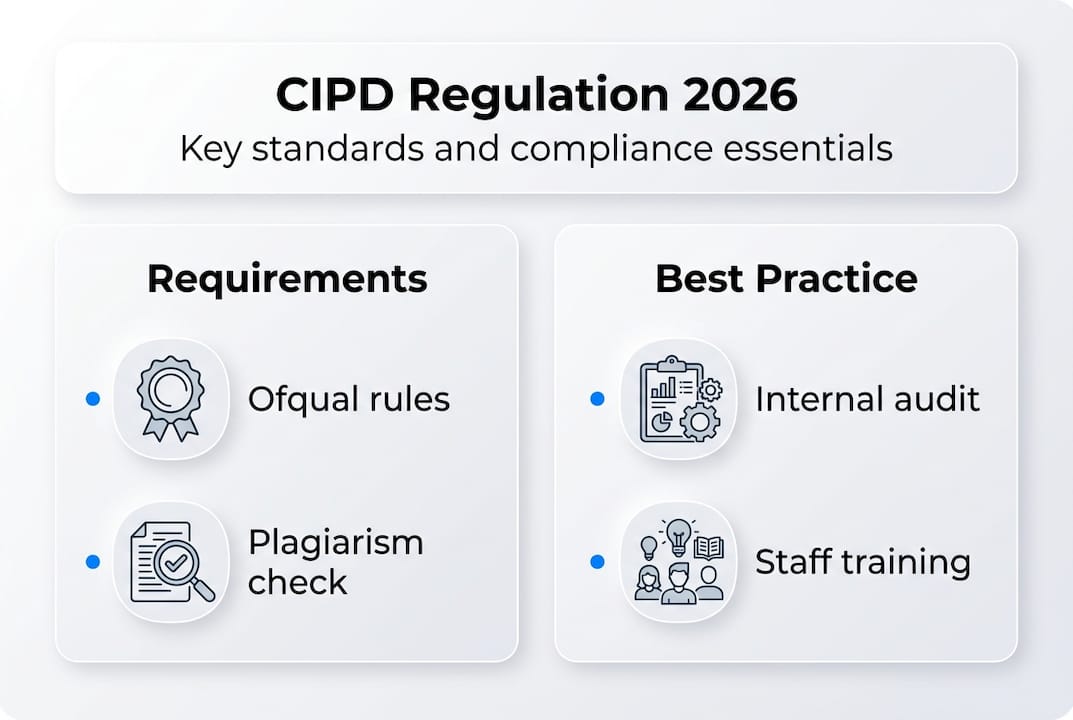
Technology transforms compliance from administrative burden into strategic advantage. Modern platforms automate plagiarism scanning, maintain version-controlled marking records, generate audit-ready reports, and flag potential inconsistencies for human review. These tools don't replace professional judgement but enhance it by handling routine checks and documentation.
Key compliance areas requiring robust systems include:
- Secure storage of learner work with access controls and backup procedures
- Documented evidence of all moderation activities and outcomes
- Clear audit trails showing who marked which assignments and when
- Standardised templates ensuring consistent feedback quality
- Regular calibration exercises maintaining marker alignment
Pro Tip: Schedule quarterly mock audits where senior staff review random samples of your documentation, identifying gaps before external quality assurers arrive.
Centres achieving consistent compliance share common characteristics. They invest in staff development ensuring all markers understand current requirements. They use technology strategically, automating routine tasks whilst preserving human oversight of critical decisions. They maintain open communication with CIPD, seeking clarification when requirements seem unclear rather than making assumptions.
Statistics reveal that centres using integrated plagiarism detection and marking technology report 40% fewer compliance issues during external audits compared to those relying on manual processes. This efficiency gain frees educators to focus on improving teaching quality rather than administrative firefighting.
Regular preparation proves more effective than crisis response. Maintain current knowledge of regulatory updates through CIPD bulletins and Ofqual announcements. Review your processes against published standards at least annually. Document everything, knowing that if it isn't written down, auditors will assume it didn't happen.
Best practices for educators: aligning CIPD assessments with employers and professional standards
Employer engagement separates outstanding assessment design from merely compliant approaches. Your assessments should reflect authentic workplace challenges, requiring learners to apply theoretical knowledge to realistic scenarios. The CIPD Profession Map provides detailed standards describing what effective people professionals do at each career level, offering a blueprint for assessment alignment.
Impact measurement transforms assessment from a qualification hurdle into a development tool. Track metrics showing how learner performance correlates with workplace outcomes. Do those achieving higher grades demonstrate stronger on-the-job performance? Can you identify specific assessment tasks that best predict future success? This data informs continuous improvement whilst demonstrating value to employers investing in staff development.
Ofqual's regulatory approach has evolved towards agile enforcement prioritising long-term standards rather than rigid compliance checking. This shift means centres demonstrating strong self-regulation face less intrusive oversight, whilst those showing persistent issues receive targeted intervention. Understanding this risk-based model helps you position your centre favourably.
| Regulatory Approach | Statutory Requirements | Flexible Implementation |
|---|---|---|
| Plagiarism detection | Must use approved software | Choice of specific platform |
| Moderation sampling | Minimum sample sizes apply | Additional sampling at centre discretion |
| Marker qualifications | Relevant expertise required | Various routes to demonstrate competence |
| Assessment security | Controlled conditions for certain tasks | Centre determines specific arrangements |
| Records retention | Minimum periods specified | Extended retention allowed |
Continuous quality improvement requires proactive moderation extending beyond minimum requirements. Sample more work than regulations mandate, especially when introducing new assessors or assessment methods. Use moderation meetings as development opportunities where markers discuss challenging cases and calibrate their judgement. This investment prevents drift from standards over time.
Successful centres embed these practices:
- Regular liaison with employers ensuring assessment content remains current
- Structured feedback to learners highlighting both strengths and development areas
- Peer observation amongst markers promoting consistency
- Annual review of assessment briefs against workplace trends
- Integration of emerging topics like AI ethics and hybrid working
Pro Tip: Create employer advisory panels reviewing sample assessments annually, providing feedback on relevance and rigour from a practitioner perspective.
The Profession Map's recent updates reflect evolving workplace demands, including enhanced focus on data literacy, ethical decision making, and inclusive practice. Your assessments should incorporate these themes, ensuring learners develop capabilities employers actually need. This alignment benefits everyone: learners gain marketable skills, employers receive qualified staff, and your centre builds reputation for quality.
Expert CIPD assessment best practices increasingly leverage technology for efficiency without sacrificing the human judgement essential to fair evaluation. The goal isn't automating assessment but augmenting educator capability, allowing you to focus expertise where it matters most.
Boost assessment quality with AI-assisted marking from EduMark
Navigating complex regulatory requirements whilst maintaining marking consistency across multiple assessors presents ongoing challenges for CIPD centres. EduMark delivers AI-assisted CIPD assignment marking specifically designed to support compliance and quality assurance.
Our platform integrates mandatory plagiarism detection with structured marking workflows, ensuring every assessment meets Ofqual standards. You'll maintain complete human oversight whilst benefiting from AI-driven consistency checks, detailed feedback templates, and comprehensive audit trails. EduMark's marking platform streamlines moderation processes, automatically flagging potential inconsistencies for review and generating the documentation external quality assurers expect. Assessment centres using EduMark report faster turnaround times, improved marker agreement, and greater confidence during external validation. The system adapts to your existing processes rather than forcing wholesale change, making implementation straightforward even for busy centres.
FAQ
What are regulatory standards for assessments?
Regulatory standards are requirements established by bodies like Ofqual ensuring assessments measure what they claim to measure, produce consistent results, and treat all learners fairly. They cover assessment design, delivery, marking, quality assurance, and appeals processes. These standards protect qualification credibility and learner interests.
How do centres ensure compliance with CIPD assessment regulations?
Centres achieve compliance by following published assessment specifications without modification, implementing robust internal moderation, using mandatory plagiarism detection software, and maintaining detailed records of all assessment activities. Regular staff training and preparation for external audits reinforce consistent practice. Strong documentation proves compliance when external quality assurers review centre operations.
Can centres make changes to qualification criteria or assessment briefs?
No, centres must not alter any qualification elements including learning outcomes, assessment criteria, or task briefs. Such modifications violate Ofqual conditions and CIPD requirements, potentially nullifying learner achievements and triggering sanctions against the centre. All learners must meet identical standards regardless of which centre delivers their qualification.
Why is plagiarism detection mandatory for CIPD assessments?
Mandatory plagiarism detection ensures all submitted work represents authentic learner effort, protecting qualification integrity and fairness. It aligns with Ofqual requirements that assessments accurately measure individual capability. Compulsory use across all centres creates consistent standards and maintains employer confidence in CIPD qualifications. Detection software provides documented evidence supporting academic integrity.
How does Ofqual's risk-based regulation affect CIPD centres?
Ofqual applies lighter oversight to centres demonstrating strong compliance track records whilst intensifying scrutiny of those showing persistent issues. Centres with robust self-regulation, clear documentation, and positive external validation reports benefit from reduced administrative burden. This approach rewards quality and encourages continuous improvement rather than minimum compliance.
What role does the CIPD Profession Map play in assessment design?
The Profession Map defines standards for effective people practice at each career level, providing detailed descriptions of required knowledge, skills, and behaviours. Assessment designers use these standards to ensure tasks measure authentic workplace capabilities. Alignment with the Map ensures qualifications remain relevant to employer needs and support learner career progression.