

Consistent, compliant assessment grading is one of the most demanding responsibilities in any CIPD accredited centre. When criteria are vague or inconsistently applied, assessors face mounting pressure, learners feel uncertain, and quality assurance becomes a guessing game. A well-constructed grading checklist changes that entirely. Rubrics improve accuracy and reduce learner anxiety when shared at the start of an assignment. This article walks you through the essential components of a CIPD grading checklist, how to build one from scratch, which grading method suits your context, and how to put it all into practice on real assignments.
Table of Contents
- The essentials of a CIPD assessment grading checklist
- Building a reliable grading rubric: step-by-step framework
- Comparing checklist grading methods: analytic, holistic, and single-point
- Applying checklist grading to real CIPD assignments
- Why less is more: the overlooked power of focused CIPD checklists
- Streamline your CIPD grading with AI-powered checklists
- Frequently asked questions
Key Takeaways
| Point | Details |
|---|---|
| Checklist clarity matters | Checklists improve grading consistency, compliance, and feedback quality. |
| Less is more | A focused checklist with 4-6 criteria avoids confusion and makes grading easier. |
| Share criteria early | Giving students the checklist upfront reduces anxiety and sharpens self-assessment. |
| Pilot and adapt | Test your checklist regularly and update it in response to bias and usage findings. |
The essentials of a CIPD assessment grading checklist
With the challenge defined, it is crucial to know what an effective checklist for CIPD assessments fundamentally requires. Unlike many academic qualifications, CIPD qualifications use criterion-referenced assessments with Pass/Fail grading, meaning learners must satisfy every criterion rather than achieve an overall grade. There is no Merit or Distinction for diplomas. Every single outcome must be met. That changes how you design your checklist entirely.
A strong CIPD assessment checklist covers three core dimensions:
- Knowledge: Does the learner demonstrate accurate understanding of HR concepts, theory, and relevant legislation?
- Application: Is the theory applied to a real or realistic workplace context with credible examples?
- Critical thinking: Does the learner evaluate, challenge assumptions, or propose reasoned recommendations?
Each dimension should have specific, observable descriptors rather than vague statements like "shows understanding." Vague descriptors are where most checklists fall apart. If two assessors read the same criterion and reach different conclusions, the checklist is not doing its job.
Common pitfalls to avoid include:
- Missing learning outcomes entirely, particularly those tied to the CIPD Profession Map
- Using overlapping criteria that make it unclear which box to tick
- Writing descriptors in passive or ambiguous language
- Failing to distinguish between minimum pass evidence and stronger evidence
"A checklist that cannot be applied consistently by two different markers is not a checklist. It is an opinion."
For quality and compliance for assessors, the language in each criterion matters enormously. Use action verbs such as identifies, analyses, evaluates, justifies, and applies to make expectations concrete and measurable.
Pro Tip: Draft each checklist item as a sentence beginning with an action verb. If you cannot complete the sentence with a specific, observable behaviour, rewrite it until you can.
Building a reliable grading rubric: step-by-step framework
Understanding the basics makes it much easier to actually build a checklist that stands up to scrutiny. Best practice rubric design follows a clear sequence: identify learning outcomes, create criteria, provide observable behaviours, differentiate levels, and review for bias and clarity. For CIPD, that sequence maps directly onto the qualification's assessment brief and Profession Map standards.
Here is a practical five-step framework:
- Map to learning outcomes: Start with the official assessment brief. Every checklist item must trace back to a stated learning outcome. If it does not appear in the brief, it should not appear in your checklist.
- Write observable criteria: Translate each outcome into a specific, visible behaviour. Instead of "understands diversity," write "identifies at least two organisational diversity challenges and proposes evidence-based solutions."
- Assign pass descriptors: For each criterion, define the minimum standard of evidence required to pass. Be explicit. Ambiguity here is where inconsistency creeps in.
- Pilot test on real samples: Before rolling out a new checklist, apply it to three to five anonymised submissions. If markers disagree on outcomes, refine the descriptors before live use.
- Review for bias and overlap: Read each criterion asking whether it could disadvantage any group or whether two criteria are effectively measuring the same thing.
A well-structured structured feedback guide will also help you align checklist criteria with the written feedback you provide, so learners receive comments that directly reference the standards they were assessed against.
"Pilot testing is not optional. It is the only way to know whether your checklist works before it affects real learners."
Pro Tip: Limit your checklist to four to six criteria. Beyond that, markers begin to lose focus, and learners struggle to prioritise their effort. Fewer, sharper criteria consistently outperform long, exhaustive lists.

Comparing checklist grading methods: analytic, holistic, and single-point
You have got your framework. Now let us see how the main checklist approaches match up for your context. Contrasting rubric grading methods shows that holistic grading is faster but provides less feedback, analytic grading is detailed but more complex to apply, and single-point grading is growth-focused but carries higher subjectivity risk.
| Method | Speed | Detail | Bias risk | Best for |
|---|---|---|---|---|
| Analytic | Slower | High | Lower | Complex written assignments |
| Holistic | Faster | Low | Moderate | Short reflective tasks |
| Single-point | Moderate | Moderate | Higher | Developmental feedback |
For most CIPD diploma assignments, analytic grading is the strongest choice. It aligns naturally with criterion-referenced Pass/Fail requirements because each criterion is assessed independently. Holistic grading works well for shorter reflective pieces where speed matters and detailed breakdown is less critical. Single-point rubrics, which describe only the pass standard and leave space for qualitative comments, suit formative feedback well but carry a higher risk of inconsistency between markers.
Inter-rater reliability is a key quality measure here. The standard benchmark is 80% agreement between independent markers on the same submission. Reaching that benchmark consistently requires:
- Clear, specific descriptors at each criterion level
- Regular standardisation meetings where markers discuss borderline cases
- A process for resolving disagreements before results are confirmed
Digital tools that streamline workflows can also support consistency by flagging divergent marks automatically, prompting markers to review before finalising.
Applying checklist grading to real CIPD assignments
Choosing a grading method is only half the battle. Here is how a checklist works on real assignments. The CIPD assessment emphasis is on evidence of impact, workplace relevance, and alignment to Profession Map standards. Your checklist must reflect that, not just theoretical knowledge.
Consider a Level 5 assignment asking learners to evaluate a people practice initiative. A mapped checklist might include:
- Identifies a specific workplace initiative with clear context
- Analyses the impact using at least one recognised HR model
- Evaluates outcomes with reference to organisational data or stakeholder feedback
- Aligns recommendations to the CIPD Profession Map values
Centres that have introduced structured checklists report measurable improvements in grading consistency. The table below illustrates a typical pattern:
| Metric | Before checklist | After checklist |
|---|---|---|
| First-time pass rate | 61% | 79% |
| Assessor disagreement rate | 22% | 8% |
| Average feedback turnaround | 9 days | 5 days |
Sharing the checklist with learners before submission is one of the highest-impact steps you can take. It reduces anxiety, encourages self-assessment, and means learners arrive at submission with a clearer understanding of what is expected. Pair this with assessment compliance tips to ensure your process meets regulatory requirements end to end.
For effective feedback in 2026, consider asking learners to complete a self-assessment against the checklist before submitting. Markers can then compare their own judgement with the learner's, which surfaces misunderstandings early and makes feedback conversations far more productive.
Pro Tip: Build a brief self-assessment column directly into your checklist template. A simple "Learner evidence" column next to each criterion takes seconds to complete and dramatically improves submission quality.
Why less is more: the overlooked power of focused CIPD checklists
Most checklists fail not because they are poorly written, but because they try to cover everything. We have seen checklists with fourteen criteria, sub-criteria, and weighted scoring matrices that leave both markers and learners exhausted before the assessment even begins. The result is not rigour. It is noise.
Experienced assessors consistently find that four to six well-written criteria produce better consistency and stronger compliance outcomes than longer lists. When criteria are focused, markers spend less time interpreting and more time evaluating. Learners spend less time second-guessing and more time producing quality evidence.
There is also a deeper principle at work. A focused checklist forces you to decide what actually matters in an assessment. That decision is itself a quality assurance act. If you cannot reduce your checklist to six criteria without feeling you are missing something critical, the assessment brief may need revisiting.
Automated assessment benefits become far more realisable when checklists are focused. AI-assisted tools can apply consistent criteria at scale, but only when those criteria are specific and bounded. A fourteen-point checklist with overlapping descriptors will produce inconsistent automated outputs just as it produces inconsistent human ones. Simplicity is not a compromise. It is the standard.
Streamline your CIPD grading with AI-powered checklists
Robust checklists are the foundation of reliable CIPD assessment grading. But building, applying, and maintaining them across a busy centre takes time and careful coordination.
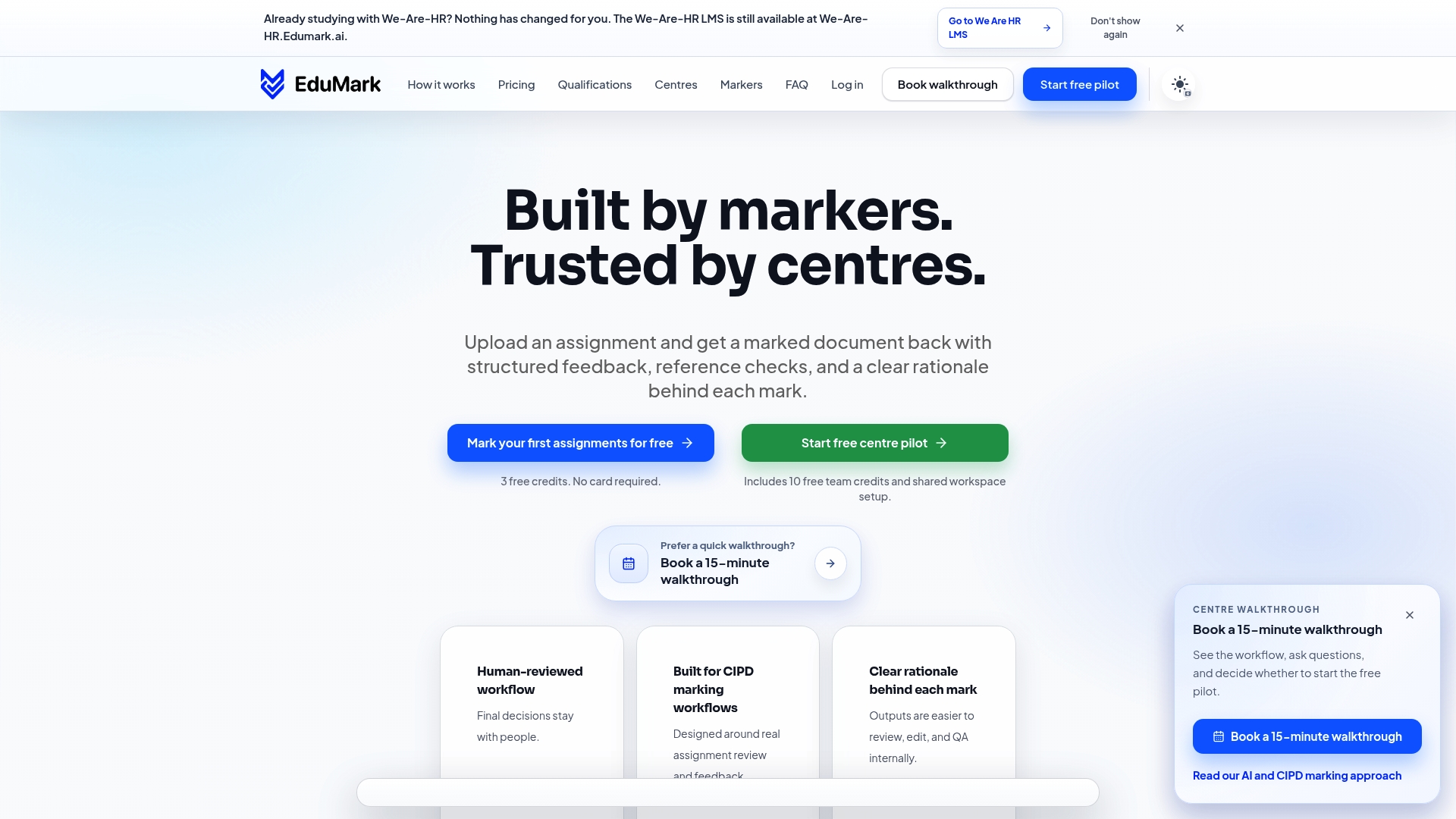
AI-assisted CIPD marking through EduMark.ai brings your checklist criteria directly into the marking workflow. The platform applies your criteria consistently across every submission, flags borderline cases for human review, and embeds structured feedback directly into learner documents. You get faster turnaround, stronger inter-rater reliability, and a clear audit trail for quality assurance. If you are ready to move beyond manual checklists and into a smarter, more scalable approach, EduMark.ai is built precisely for CIPD centres like yours.
Frequently asked questions
What makes a checklist suitable for CIPD assessment grading?
A checklist for CIPD must map clearly to each learning outcome, use specific action-verb descriptors, and align to Profession Map standards with evidence of real workplace application.
Should students see the grading checklist before submitting their work?
Yes. Sharing rubrics pre-assignment supports self-assessment, reduces submission anxiety, and consistently improves the quality of evidence learners provide.
How many criteria should a CIPD grading checklist have?
Limit to four to six criteria using specific action-verb language, and align the weight of each criterion to the priorities stated in the assessment brief.
What is the recommended method for checking grading consistency across markers?
Aim for at least 80% inter-rater agreement by pilot testing the checklist on anonymised samples and refining descriptors before live use.
Recommended
- CIPD assessment checklist: essential criteria and tools
- Best practices for CIPD assessors: quality and compliance
- Structured assessment feedback guide for CIPD educators
- How to provide assessment feedback effectively in 2026
Sources & further reading
See how EduMark connects learning, assessment and your team.
Explore EduMark →