

TL;DR:
- Rigorous assessment moderation, compliance validation, and learner diagnostics are essential for CIPD approval.
- A structured 9-step audit process ensures comprehensive review of training center processes.
- Integrating digital tools like AI-assisted platforms enhances consistency and efficiency in quality assurance.
Even the most well-regarded CIPD training centres face routine scrutiny. CIPD audits CPD records annually, and a single gap in your documentation or moderation process can put your centre's approved status at serious risk. The stakes are high, and the margin for error is slim. A structured, evidence-based review checklist is not a luxury for busy administrators; it is the backbone of consistent quality and regulatory confidence. This article gives you a practical, field-tested checklist framework drawn from CIPD specifications, ISOtrain's compliance model, and ISO 9001 standards, so you can audit your own processes with clarity and purpose.
Table of Contents
- Key criteria for a training centre review checklist
- 9-step audit checklist for regulated training centres
- Comparison: ISOtrain, ISO 9001, and CIPD moderation standards
- Monitoring, impact evaluation, and continual improvement
- What most checklists miss: From paperwork to real transformation
- Streamline your review process with advanced tools
- Frequently asked questions
Key Takeaways
| Point | Details |
|---|---|
| Checklist essentials | A strong review checklist must cover assessment moderation, compliance, and impact measurement for CIPD centres. |
| Framework adaptation | General audit models like ISOtrain and ISO 9001 can be adapted for CIPD but always align with current CIPD requirements. |
| Continual improvement | Ongoing monitoring and reflective practice turn checklists into tools for meaningful development, not just compliance. |
| Digital solutions | Automated tools support efficiency, audit-readiness, and accurate evidence collection. |
Key criteria for a training centre review checklist
Having established the need for rigorous compliance, we turn to the foundations of an effective review checklist. Not every centre starts from the same point, and that is fine. What matters is that your checklist covers the right ground systematically.
The CIPD Associate Diploma specification makes clear that centres must meet requirements for assessment moderation, compliance validation, and learner suitability diagnostics. These are not optional extras. They are the minimum threshold for operating as an approved centre. Miss any one of them and you are exposed during an external audit.
Here are the essential pillars every CIPD-oriented review checklist must include:
- Assessment moderation procedures: sampling strategies, standardisation meetings, and inter-assessor reliability checks
- Compliance and validation protocols: ensuring all assessments align with current CIPD qualification specifications
- Learner suitability diagnostics: entry criteria, prior learning recognition, and reasonable adjustments
- Alignment to the CIPD Profession Map: mapping learning outcomes and assessment tasks to the Map's core behaviours and values
- Record keeping and documentation: maintaining accessible, accurate, and audit-ready evidence files
- Effectiveness and impact measurement: tracking learner outcomes, progression, and employer feedback
One thing worth knowing: as no official CIPD-specific centre checklist exists in the public domain, top-performing centres adapt general quality assurance frameworks creatively to fit their context. That adaptability is itself a marker of quality.
"The best checklists are living documents. They reflect your centre's specific learner cohort, your assessors' development needs, and the evolving CIPD standards, not just a generic compliance template."
For a deeper look at what belongs in a well-structured quality document, the assessment checklist essentials guide offers practical starting points. You should also review your moderation processes to ensure sampling is both representative and defensible under CIPD audit guidance.
9-step audit checklist for regulated training centres
With the main pillars defined, let's break the review process into clearly actionable audit steps. Structure removes ambiguity. When every assessor and quality lead follows the same sequence, gaps become visible before an auditor finds them.
Adapted from ISOtrain's nine compliance elements and mapped to CIPD requirements, here is a practical nine-step audit checklist:
- Training records audit: Verify all learner records are complete, current, and stored securely in line with GDPR requirements.
- SOP linkage to Profession Map: Confirm that standard operating procedures reference the relevant CIPD Profession Map standards and behaviours.
- Validation of assessment materials: Check that all tasks, briefs, and marking criteria reflect the current qualification specification.
- Assessment sampling and moderation: Review a representative sample of marked work to confirm consistency across assessors.
- Requalification and CPD tracking: Ensure assessors hold current qualifications and have documented continuing professional development.
- Audit trail integrity: Confirm that every assessment decision has a documented rationale, including borderline and referred cases.
- Electronic signatures and approvals: Check that digital sign-off processes meet both internal policy and regulatory requirements.
- Reporting and escalation procedures: Verify that non-compliance findings are logged, escalated appropriately, and resolved within agreed timescales.
- Quality management system (QMS) review: Assess whether your QMS documentation is up to date and reflects actual practice rather than aspirational policy.
Pro Tip: Use digital checklists with automated reminders for steps that recur on a fixed schedule, such as moderation sampling and assessor CPD reviews. This creates a live audit trail and removes the risk of tasks slipping between review cycles. For more on this, see assessor best practices and how automated audits can reduce administrative burden significantly.
Comparison: ISOtrain, ISO 9001, and CIPD moderation standards
It's easy to get lost among overlapping standards. This table clarifies which checklist elements map to each framework and where you need to adapt rather than simply adopt.
| Checklist element | ISOtrain | ISO 9001:2015 | CIPD moderation |
|---|---|---|---|
| Training records management | ✓ Core | ✓ Core | ✓ Required |
| Competence and development planning | ✓ Included | ✓ Core requirement | ✓ Assessor CPD |
| SOP and standards linkage | ✓ Core | ✓ Included | Adapt to Profession Map |
| Assessment validation | ✓ Core | Partial | ✓ Specification-aligned |
| Moderation sampling | Not explicit | Not explicit | ✓ Mandatory |
| Learner suitability diagnostics | Not included | Not included | ✓ Required |
| Audit trail and e-signatures | ✓ Core | ✓ Included | ✓ Required |
| Learner outcome and impact data | Partial | Partial | ✓ Central focus |
A striking fact worth noting: 100% of CIPD-approved centres undergo moderation sampling as part of their quality assurance obligations. No centre is exempt, regardless of size or track record.

The practical takeaway here is straightforward. ISOtrain and ISO 9001 give you a robust operational backbone, particularly for record integrity and process documentation. But neither framework was built with CIPD's Profession Map or learner suitability requirements in mind. You must layer those elements on top. For a fuller picture of how these frameworks interact with CIPD regulatory standards, it is worth reviewing the specific compliance obligations for 2026.
Monitoring, impact evaluation, and continual improvement
Having compared checklist frameworks, let's ensure your processes actually drive improvement rather than just tick boxes. Completing a checklist once a year is not quality assurance. It is a snapshot. Real quality lives in what happens between audits.
Effective ongoing monitoring relies on a combination of tools and habits:
- Record sampling between formal moderation cycles: Pull a small sample of assessed work monthly to catch drift in marking standards early.
- Standardisation meetings: Bring assessors together regularly to discuss borderline cases and agree on interpretation of criteria.
- Learner feedback analysis: Systematically review end-of-programme feedback for patterns, not just individual comments.
- Employer and stakeholder input: Where possible, gather data on how learners are applying their CIPD learning in the workplace.
CIPD audits evaluate learning impact through reflective CPD records, and the same principle applies to your internal monitoring. Evidence of impact is more persuasive than evidence of process alone.
The IQA sampling and standardisation process provides a useful model for structuring your internal quality assurance calendar. Here is a simple comparison of monitoring methods:
| Method | Frequency | What it measures | Effort level |
|---|---|---|---|
| Record sampling | Monthly | Marking consistency | Low |
| Standardisation meetings | Termly | Assessor alignment | Medium |
| Learner outcome tracking | End of programme | Qualification success rates | Medium |
| External benchmarking | Annual | Performance vs sector norms | High |
For benchmarking training quality against sector norms, CIPD's own resources offer a useful reference point. Pairing this with robust grading accuracy practices and structured feedback processes creates a monitoring system that genuinely informs improvement.
Pro Tip: Build a set of "learner lens" questions into every monitoring cycle. Ask: "Would this feedback help a learner understand exactly what to do differently?" If the answer is no, the process needs attention before the next audit.
What most checklists miss: From paperwork to real transformation
Here is an uncomfortable truth that most quality assurance guidance sidesteps: a perfectly completed checklist can coexist with genuinely poor learner experience. The two are not mutually exclusive. Compliance and quality are related, but they are not the same thing.
The tick-box mentality is understandable. Audits are stressful, documentation takes time, and administrators are stretched. But when the checklist becomes the goal rather than the means, you lose sight of what it is actually for: producing well-supported, fairly assessed learners who can demonstrate real professional competence.
Transformative checklists embed three things that compliance-only versions ignore. First, they include self-review prompts that ask assessors to reflect on their own practice, not just confirm it happened. Second, they track feedback quality as a measurable outcome, not just feedback volume. Third, they connect assessment data to learner progression and employer outcomes, creating a feedback loop that informs future programme design.
Reviewing your process every six months through the lens of feedback and compliance keeps your checklist honest. Build in at least two custom elements that are unique to your centre's specific challenges. A checklist that could belong to any centre probably belongs to none of them.
Streamline your review process with advanced tools
Ready to put your checklist into action? Knowing what to check is only half the challenge. The other half is having systems that make it practical to check consistently, at scale, without adding hours to already stretched teams.
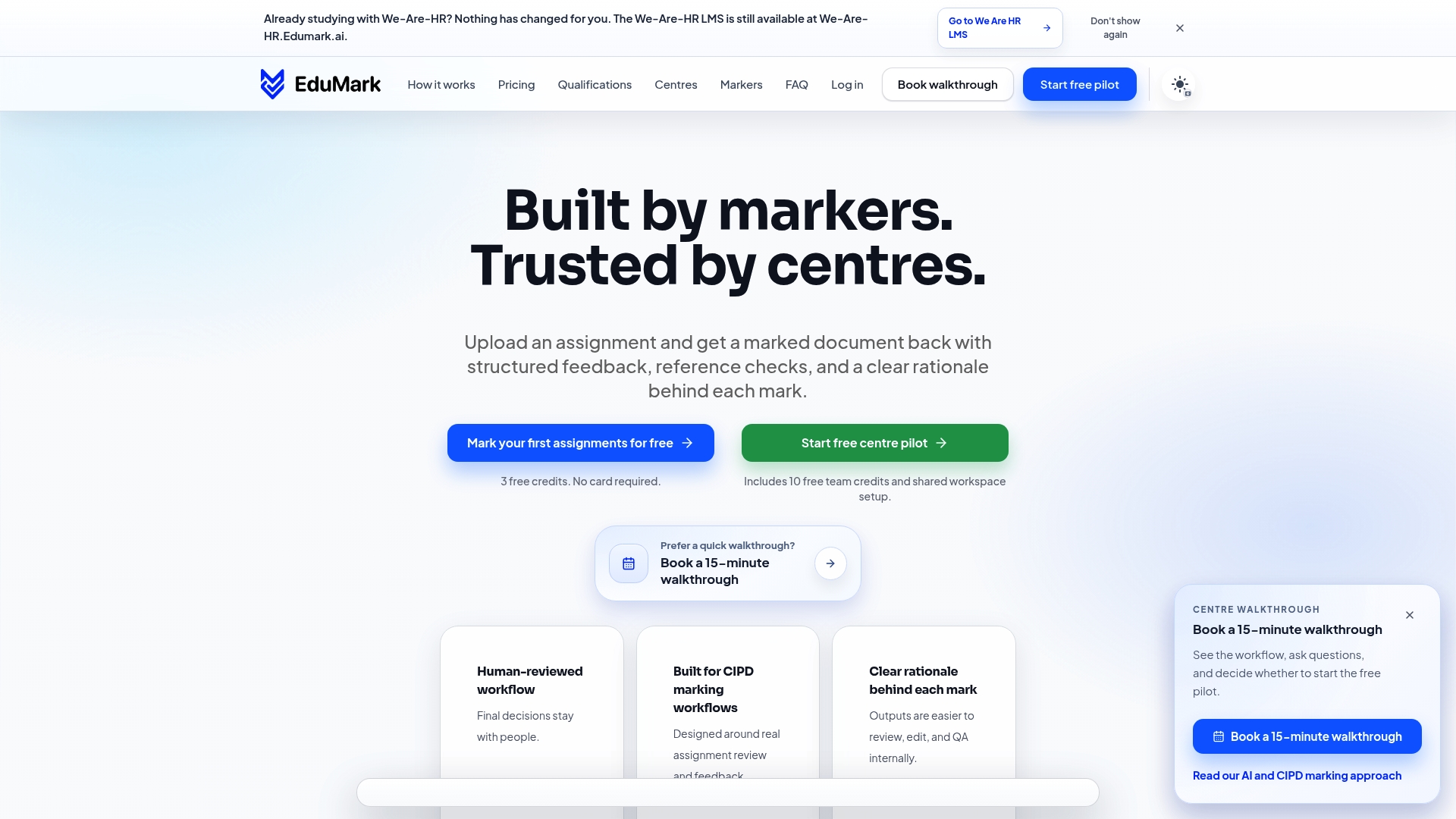
EduMark.ai's AI-assisted marking platform is built specifically for CIPD training centres that need to maintain assessment quality without sacrificing speed or compliance. From automated moderation support and inline feedback to detailed audit-ready review summaries embedded directly in Word documents, EduMark gives your team the infrastructure to turn a good checklist into a genuinely effective quality system. Every submission is handled within a human-reviewed, GDPR-compliant environment. Book a demo and see how your centre can move from reactive compliance to proactive quality assurance.
Frequently asked questions
What is the most important element in a CIPD training centre review checklist?
Assessment moderation and evidence are the most critical elements, ensuring all processes align directly to CIPD's Profession Map and qualification specifications. Without robust moderation, every other checklist item is built on an unstable foundation.
How often should training centres review their quality assurance checklist?
Centres should review checklists at least annually, ideally after any CIPD specification updates, with many high-performing centres conducting semi-annual internal reviews. Annual CIPD audits mean your documentation must always reflect current practice, not last year's intentions.
How do you evidence learning impact during a CIPD audit?
You should submit reflective CPD records that demonstrate how learning was applied in practice and what measurable outcomes resulted. CIPD audit requirements specify that these records must show genuine reflection rather than a simple log of activities attended.
Can ISO 9001 and ISOtrain checklists be fully adopted for CIPD centre reviews?
These frameworks provide a strong operational foundation but require adaptation to incorporate CIPD-specific moderation sampling and Profession Map alignment. ISO 9001 and ISOtrain frameworks complement CIPD criteria without replacing them.
What tools can streamline training centre compliance?
Digital platforms offering automated assessment workflows, secure record keeping, and audit-ready reporting increase consistency and reduce administrative load significantly. Automated compliance tools support centre readiness by creating live audit trails that remove reliance on manual tracking.
Recommended
- CIPD assessment checklist: essential criteria and tools
- Ensure compliance with assessment feedback in CIPD qualifications
- Best practices for CIPD assessors: quality and compliance
- Understanding regulatory standards for CIPD assessments in 2026
Sources & further reading
See how EduMark connects learning, assessment and your team.
Explore EduMark →