
TL;DR:
- Compliance gaps threaten assessments with audit failures, suspension, or revoked accreditation.
- Effective checklists must include secure storage, records, invigilation, moderation, and AI oversight.
- Using technology like AI-supported tools enhances audit readiness and ensures ongoing assessment integrity.
Imagine an auditor arrives at your assessment centre unannounced and asks to see your compliance records. Can you produce complete invigilation logs, marking rationale, moderation notes, and GDPR-compliant storage evidence within the hour? For many centres, the honest answer is no. Compliance gaps do not just cause embarrassment; they risk failed audits, suspended programmes, and in serious cases, revoked accreditation. Assessment centres and CIPD training providers face mounting pressure to demonstrate regulatory adherence at every stage of the marking cycle. This article walks you through building and applying an assessment compliance checklist that actually holds up under scrutiny.
Table of Contents
- Core components of an effective assessment compliance checklist
- Preparing your centre: Tools, documentation, and prerequisite checks
- Implementing and using checklists: Step-by-step process for exam sessions and coursework
- Verification, moderation and troubleshooting: Post-assessment compliance
- What most compliance audits miss and how checklists actually improve integrity
- Upgrade your assessment compliance with smart tools
- Frequently asked questions
Key Takeaways
| Point | Details |
|---|---|
| Checklist essentials | An effective compliance checklist covers secure storage, staff training, marking schemes, and audit records. |
| AI compliance rules | AI cannot act as the sole marker and human moderation is required for regulatory adherence. |
| Preparation matters | Comprehensive preparatory steps and role assignments reduce errors and audit failures. |
| Ongoing verification | Post-assessment reviews and troubleshooting are essential to maintain continuous compliance. |
| Beyond the checklist | Quality culture and peer moderation are vital for lasting integrity, not just written checklists. |
Core components of an effective assessment compliance checklist
Having outlined the importance of compliance, the first step is understanding exactly what must be included in your checklist. Not all checklist items carry equal weight. Some are non-negotiable regulatory requirements; others represent good practice that strengthens your quality assurance position.
JCQ's Instructions for Conducting Examinations give detailed checklist content areas for exam centres, covering everything from secure paper storage to post-exam documentation. Alongside this, CIPD providers rely on marking criteria checklists aligned to Level 7 requirements and AI safeguards, making the stakes particularly high for specialist training organisations.
Here are the core components every checklist must address:
- Secure storage protocols: Confirmed locked storage for exam papers, scripts, and digital submissions, with access logs.
- Assessment records: Candidate registration, attendance sheets, incident reports, and mark sheets retained for the required period.
- Invigilation training records: Signed evidence that all invigilators have completed current-year training.
- Rubric and mark scheme use: Confirmation that assessors used the correct, approved rubric and recorded their rationale.
- AI moderation logs: Where AI tools assist in marking, a documented human review trail is mandatory.
- Appeals and complaints route: Accessible, documented procedure for candidates and assessors.
| Document | Responsible party | When required |
|---|---|---|
| Invigilation training log | Centre manager | Before each assessment window |
| Secure storage access record | Exams officer | Ongoing, updated per session |
| Mark scheme version confirmation | Lead assessor | Before marking begins |
| Moderation summary | Internal moderator | Post-marking, pre-results |
| AI involvement disclosure | Quality assurance lead | Per submission where AI is used |
| Incident report | Invigilator | Immediately after any incident |
Distinguishing between must-have and good-practice items matters because it shapes how you prioritise resources. Regulatory items protect your accreditation; quality assurance items protect your reputation and learner outcomes. A centre review checklist can help you separate these two categories clearly. You can also cross-reference your records against an educator compliance checklist to confirm nothing is missed before an audit window opens.
Pro Tip: Assign a named owner to every checklist item. When responsibility is shared across a team without named accountability, steps fall through the gaps. One owner per item means one person to chase.
Preparing your centre: Tools, documentation, and prerequisite checks
Once you know what elements to include, the next step is collecting the right tools and verifying readiness. Preparation is where most centres either gain or lose their audit advantage.

Ofqual requires secure handling, prohibition of AI as the sole marker, and staff standardisation prior to assessments. This means preparation is not simply gathering paperwork; it involves active confirmation that every person involved in the assessment cycle is trained, briefed, and operating from the correct version of each document.
| Requirement area | JCQ focus | Ofqual focus | CIPD focus |
|---|---|---|---|
| Secure storage | Physical and digital | Physical, with digital audit trail | Digital only (submission platforms) |
| Staff training | Invigilator certification | Standardisation and moderation | Assessor CPD and AI literacy |
| AI involvement | Not addressed directly | Human oversight mandatory | AI safeguard disclosure required |
| Appeals process | Defined appeals window | Regulatory complaints route | Internal and awarding body route |
Before any assessment begins, run through this pre-assessment readiness protocol:
- Confirm all exam papers or digital submissions are stored securely and accessed only by authorised staff.
- Verify that every invigilator or assessor has completed current-year training and signed the relevant declaration.
- Check that the correct mark scheme or rubric version is in use, with no outstanding amendments from the awarding body.
- Confirm that complaint and appeal routes are documented, accessible, and communicated to candidates.
- Review any AI tools in use for AI grading accuracy and ensure that human moderation is built into the workflow before results are released.
Centres that treat preparation as a standalone phase rather than an ongoing discipline reduce audit risk dramatically. It is also worth noting that AI ethics for assessors is now a legitimate preparation topic; understanding where AI assistance is permitted versus where it requires additional human oversight is part of a modern compliance posture.
Implementing and using checklists: Step-by-step process for exam sessions and coursework
With everything ready, here is how to deploy your checklist to maintain integrity throughout assessments. The implementation phase is where intention meets practice, and where non-compliance most commonly surfaces.
JCQ and Ofqual set rules for exam session management and moderation to prevent non-compliance, and these rules differ depending on whether you are managing a formal exam or assessed coursework.
For exam sessions, follow this sequence:
- Open the secure storage and log paper retrieval with a timestamp and authorised signature.
- Confirm candidate identity against the registration list before papers are distributed.
- Record any late arrivals, accommodations activated, or technical incidents in real time.
- At the close of the session, collect all scripts, reseal securely, and update the access log before any materials leave the room.
- Complete the post-session checklist immediately, including incident report sign-off and script count verification.
For coursework and CIPD submissions, the process shifts:
- Confirm submission receipts are logged with timestamps against the correct learner record.
- Apply the approved rubric and document marking rationale for every band or criterion awarded.
- Where AI tools assist in marking, log the AI involvement, the confidence level flagged, and the human review in grading completed before finalising the mark.
- Pass completed marks to the internal moderator with all supporting rationale attached.
- Record any discrepancies between first and second marker, noting how they were resolved.
Pro Tip: Use colour-coded checklist sections for high-risk or novel procedures. Anything involving AI involvement or new assessors should be flagged in a distinct colour so reviewers know to apply additional scrutiny. The AI feedback reliability of any tool in use should be reviewed and documented before the assessment cycle opens.
Verification, moderation and troubleshooting: Post-assessment compliance
After assessments, it is critical to lock in compliance and correct any discovered weaknesses. The post-assessment phase is not an afterthought; it is where your audit trail is completed or broken.
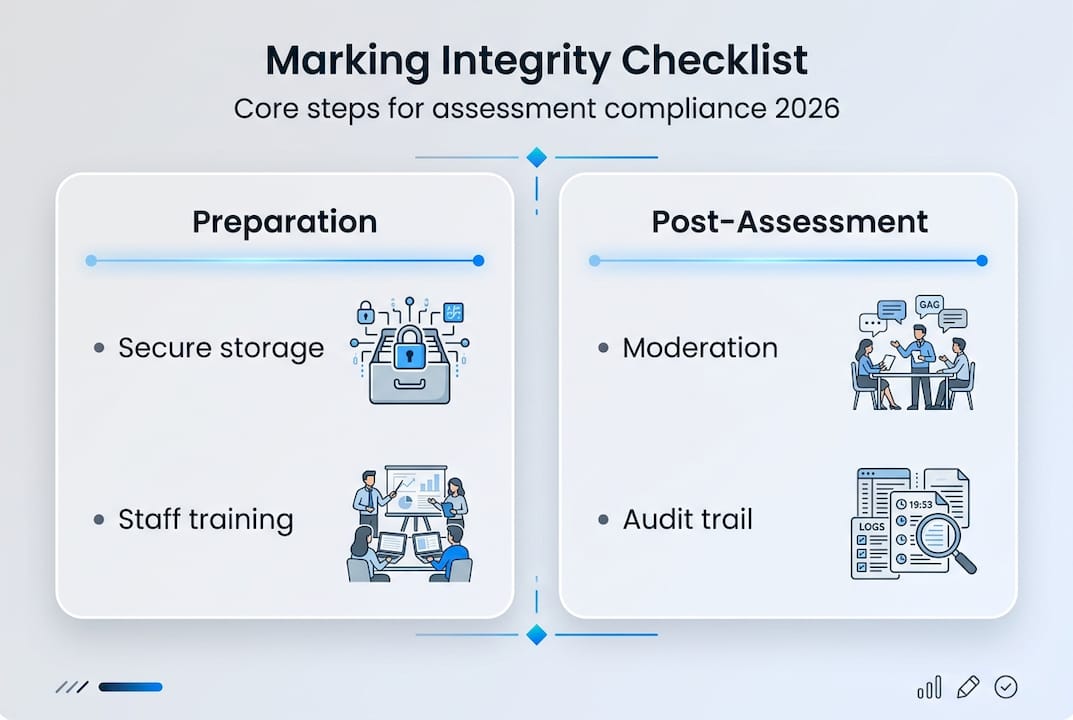
Ofqual's transparent documented process takes priority over subjective judgement, and edge cases involving AI tools or new assessors carry higher risk. This means that verification must be thorough and methodical rather than cursory.
Common post-assessment compliance failures and their fixes:
- Missing training logs: Conduct a register check immediately after marking and chase signed declarations before results are released.
- Incomplete moderation notes: Require moderators to record not just the agreed mark but the reasoning behind any change from the first marker's decision.
- No AI involvement disclosure: Introduce a mandatory field on all marking records confirming whether AI assistance was used and at what stage.
- Undated incident reports: Implement a timestamping rule; all reports must carry the date, time, and name of the reporting invigilator or assessor.
- Outdated rubric version used: Add a version-check step to the pre-marking protocol and retain a copy of the rubric used with each batch of scripts.
Regulatory reminder: Where AI tools have been used in any part of the marking process, audit evidence must include the specific tool used, the human oversight applied, and confirmation that no AI output was treated as a final mark without qualified review. Regulators will scrutinise this area closely in 2026 inspections.
Post-assessment tasks should include a full document audit trail check, peer moderation cross-referencing, and a scheduled review of the checklist itself. If an audit reveals a gap, update the checklist immediately and document what changed. The aim is not just to pass the current audit but to build towards improving marking accuracy as a continuous practice rather than a one-time exercise.
What most compliance audits miss and how checklists actually improve integrity
Beyond the step-by-step, it is crucial to grasp where most compliance efforts fall short in real practice. The uncomfortable truth is that many centres pass audits on paper while their marking culture remains inconsistent, their moderators are under-trained, and their checklists are completed retrospectively rather than in real time.
A checklist is a tool, not a guarantee. When staff treat it as a box-ticking exercise rather than a genuine quality control mechanism, compliance becomes theatre. The real value of a well-designed checklist emerges only when it is paired with ongoing assessor training, meaningful peer review, and honest internal feedback loops.
Centres that invest in cross-referencing their checklist outcomes against actual learner results and marker consistency data find something revealing: discrepancies between checklist completion and outcome quality expose exactly where the culture needs work. That kind of evidence-driven reflection, guided by assessment principles and AI, raises standards far more reliably than compliance documentation alone. Honest internal moderation, where assessors genuinely challenge each other's marks, is worth more than a perfectly formatted checklist that nobody reads critically.
Upgrade your assessment compliance with smart tools
If you are ready to reinforce your compliance approach, here is how technology can help. Maintaining the level of documentation, moderation records, and audit trails described in this article is demanding work, and doing it manually at scale introduces its own risks.
EduMark.ai offers AI marking solutions built specifically for CIPD and training centre workflows, combining structured feedback, confidence checks, and human-reviewed AI output to support every stage of your compliance checklist. From inline comments embedded in Word documents to transparent marking rationale, the platform is designed to make audit-readiness the default rather than the exception. For a deeper look at putting this into practice, the assessment checklist guide walks through how to align your centre's processes with current regulatory expectations.
Frequently asked questions
What is the most common compliance checklist mistake in assessment centres?
The most common error is incomplete record keeping, particularly missing training logs and moderation notes. Audit data reveals that weaknesses in mark scheme design rationale are among the most frequently cited compliance failures.
Does Ofqual permit AI-only marking for non-exam assessments?
No, Ofqual does not allow AI as the sole marker. Ofqual bans AI-only marking for non-exam assessments, requiring qualified human review and moderation before any mark is finalised.
Do CIPD centres need separate checklists for submission, marking, and review?
Yes, CIPD providers must follow distinct checklists for each stage, covering submission receipts, marking criteria application, and formal centre review processes to ensure full compliance.
How often should assessment compliance checklists be updated?
Update your checklists at least annually or immediately when regulatory guidance changes. JCQ updates its instructions each academic cycle, so waiting for an audit to trigger a review is too late.
Where can I find official guidance for assessment compliance checklists?
Official guidance is published by JCQ, Ofqual, and CIPD on their respective websites. Ofqual's 2026 guide for schools and colleges is a strong starting point for understanding current regulatory expectations.
Recommended
- Understanding regulatory standards for CIPD assessments in 2026
- Build a robust educator assessment checklist for CIPD compliance
- Ensure compliance with assessment feedback in CIPD qualifications
- CIPD assessment checklist: essential criteria and tools
Sources & further reading
See how EduMark connects learning, assessment and your team.
Explore EduMark →