

TL;DR:
- UK educator assessments in 2026 require compliance with both Ofsted and CIPD frameworks, emphasizing evidence over quantity.
- AI tools can enhance efficiency and consistency but must be transparently disclosed and ethically managed to mitigate risks.
- Building a dynamic, thoughtful checklist and integrating AI responsibly supports compliance, professional judgment, and ongoing quality improvement.
Assessment coordinators and HR training managers across the UK are facing a familiar frustration in 2026: multiple guidance sources, shifting AI policies, and no single definitive framework to follow. No specific educator assessment checklist for 2026 exists from CIPD or UK education authorities; the closest resources are Ofsted's ITE Inspection Toolkit effective from January 2026 and CIPD's own upgrade assessment guides. This article bridges that gap, giving you a practical, evidence-based checklist that satisfies Ofsted, CIPD, and emerging AI governance requirements, while showing you where technology can genuinely save time without compromising compliance.
Table of Contents
- Understand the 2026 regulatory landscape for educator assessment
- Essential components for your educator assessment checklist
- Integrate AI tools to streamline assessment and evidence collection
- Verification, feedback, and evidence for compliance and quality
- A fresh perspective: The uncomfortable truth about educator checklists and AI
- Streamline CIPD assessment with AI-powered solutions
- Frequently asked questions
Key Takeaways
| Point | Details |
|---|---|
| No single checklist standard | Combine elements from Ofsted and CIPD guidance for a robust, practical assessment process. |
| AI supports but does not replace review | AI tools can enhance efficiency and objectivity, but require careful oversight and transparent use. |
| Evidence and feedback are critical | Document all assessment decisions, feedback, and CPD to satisfy compliance and audit requirements. |
| Adopt a flexible approach | Tailor your checklist to regional mandates and keep depth of evidence over minimum hours. |
| Transparency in AI and compliance | Always disclose AI use in assessment and maintain ethical standards to avoid malpractice risks. |
Understand the 2026 regulatory landscape for educator assessment
Getting your assessment process right starts with knowing which frameworks actually apply to your setting. In 2026, two systems carry the most weight for UK educators and assessment coordinators: Ofsted's Initial Teacher Education (ITE) Inspection Framework and CIPD's upgrade assessment process. Neither was designed with the other in mind, yet most assessment centres need to satisfy elements of both.
The Ofsted ITE toolkit structures its evaluation around seven distinct criteria areas. According to the framework, ITE inspections evaluate inclusion, curriculum design, achievement, professional behaviours, leadership, compliance, and safeguarding. Each area requires documented evidence, not just policy statements. Inspectors look for proof that these principles are embedded in daily practice.
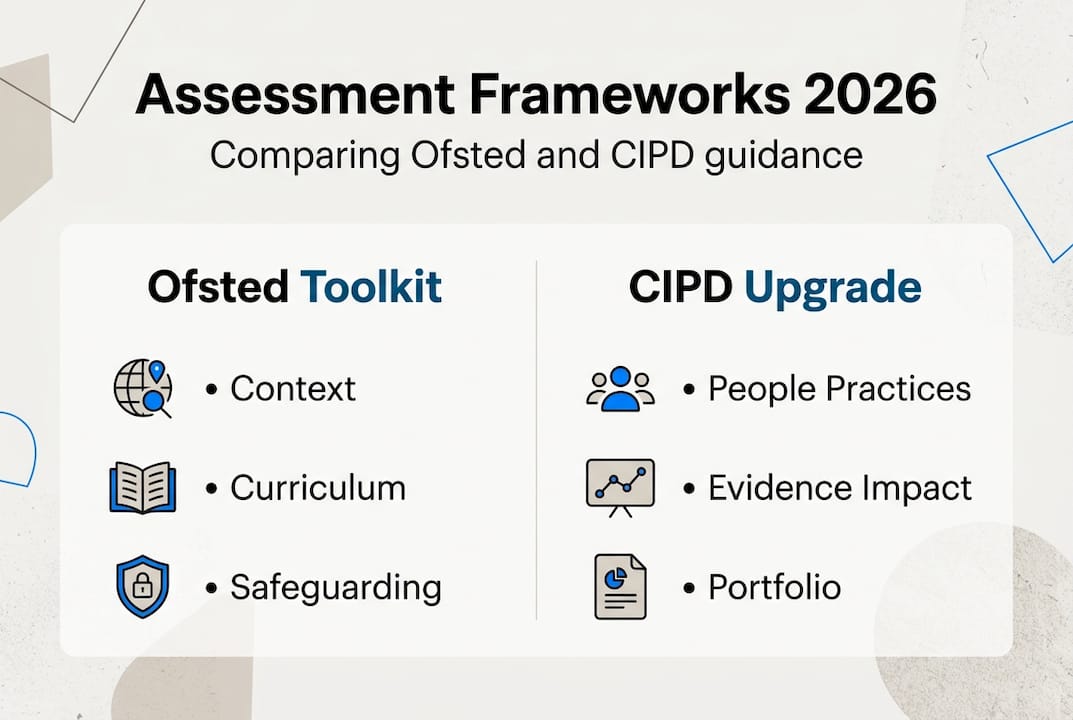
On the CIPD side, the requirements are equally specific. Upgrade assessments require evidence of people practices impact with examples drawn from the last five years. Candidates must demonstrate measurable outcomes, not simply list activities or responsibilities. This distinction matters enormously when you are helping learners prepare their portfolios.
Here is a quick comparison of what each framework prioritises:
| Area | Ofsted ITE focus | CIPD upgrade focus |
|---|---|---|
| Evidence type | Observed practice and documentation | Portfolio examples and impact statements |
| Time horizon | Current and recent practice | Last five years |
| Inclusion | Mandatory criterion | Embedded in people practice standards |
| Safeguarding | Explicit requirement | Contextual, within professional conduct |
| AI use | Provider decision, outcomes-focused | Transparent use only, no generation |
Key compliance actions to address across both frameworks:
- Document inclusion and safeguarding policies with live examples
- Map curriculum design decisions to learner outcomes
- Record CPD activity with evidence of depth, not just hours
- Maintain an audit trail for any AI-assisted processes
- Align assessment feedback with CIPD assessment standards
As one principle underpinning both frameworks makes clear: compliance is not a destination, it is an ongoing process of evidenced practice. Building your assessment checklist criteria around this principle will serve you far better than treating it as a one-off exercise.
Essential components for your educator assessment checklist
Now that the regulatory pillars are clear, you can define what belongs in a practical, actionable checklist. The good news is that Ofsted and CIPD share more common ground than they might appear to at first glance. Both value depth of evidence over volume, and both expect assessors to demonstrate professional judgement rather than mechanical compliance.
The Ofsted readiness checklist covers context, curriculum, safeguarding, attendance, SEND (Special Educational Needs and Disabilities), and CPD depth rather than hours completed. This is a significant shift from older frameworks that rewarded quantity. CPD evidence should demonstrate sustained, evidence-based learning, with depth mattering more than hours, and some topics requiring 20 to 50 or more hours of focused engagement.
Here is a comparison of manual versus AI-supported evidence gathering to help you decide where technology adds value:
| Task | Manual approach | AI-supported approach |
|---|---|---|
| Marking consistency | Varies by assessor | Standardised with human review |
| Feedback turnaround | Days to weeks | Hours with structured templates |
| Evidence collation | Manual filing and cross-referencing | Automated tagging and audit trails |
| Bias detection | Dependent on assessor awareness | Flagged systematically |
Your checklist should include the following numbered steps:
- Establish context: document your setting, learner cohort, and any SEND or inclusion considerations
- Map curriculum design to intended outcomes and record the rationale
- Confirm safeguarding policies are current, accessible, and evidenced in practice
- Collate CPD records with reflective commentary, not just attendance logs
- Review assessment feedback for structure, actionability, and alignment with quality compliance practices
- Document any AI tools used in the assessment process with clear disclosure
- Cross-reference all evidence against the relevant Ofsted or CIPD criteria
Pro Tip: Use scenario-based evidence wherever possible. Rather than listing responsibilities, describe a specific situation, the action you took, and the measurable outcome. This approach directly satisfies CIPD's impact requirement and gives Ofsted inspectors the concrete examples they are looking for. A structured feedback guide can help you frame these scenarios consistently across your team.
Integrate AI tools to streamline assessment and evidence collection
With your checklist components established, technology becomes your most practical ally for maintaining both speed and rigour. The key is knowing precisely where AI adds genuine value and where human oversight remains non-negotiable.

Purpose-built AI assessment tools can reduce subjective bias and administrative workload significantly. Learning Pool's AI Assess offers scenario-based, bias-mitigated evaluations and data analysis for competency checks. Importantly, CIPD prohibits AI for assignment generation but permits transparent AI-assisted marking when disclosed appropriately. This distinction is not a minor technicality. It defines the boundary between legitimate efficiency and academic malpractice.
Ofsted takes a similarly nuanced position. Ofsted evaluates provider decisions on AI use by focusing on outcome improvement, data privacy, and bias mitigation. Inspectors are not looking to penalise AI adoption. They are looking for evidence that providers have thought carefully about its implications and implemented appropriate safeguards.
Benefits AI tools can deliver in your assessment workflow:
- Faster marking turnaround with consistent rubric application
- Automated flagging of potential bias in feedback language
- Structured evidence collation with searchable audit trails
- Inline comments embedded directly into submitted documents
- Confidence scoring to highlight borderline cases for human review
These capabilities support AI assessment integration in a way that complements rather than replaces assessor expertise. The assessor remains the decision-maker. The AI handles the repetitive, time-consuming elements that erode consistency over large volumes of submissions.
Pro Tip: Always maintain a clear audit trail for every AI-assisted decision. Log which tool was used, what output it produced, and how a human reviewer acted on that output. Failure to disclose AI involvement in assessment is treated as malpractice under current CIPD and Ofsted guidance. Reviewing AI ethics for assessors before deploying any new tool is time well spent.
Verification, feedback, and evidence for compliance and quality
Even the most carefully constructed checklist only delivers value if your verification process is equally robust. This stage is where many assessment centres lose marks during inspection, not because the evidence does not exist, but because it is poorly organised or insufficiently linked to outcomes.
Structured verification should follow a clear sequence:
- Review all grades against the marking rubric and confirm consistency across assessors
- Check that feedback is actionable, specific, and aligned with the relevant CIPD or Ofsted criteria
- Confirm that CPD records include reflective commentary and evidence of impact
- Verify that inclusive practice documentation covers SEND, attendance, and wellbeing
- Audit any AI-assisted processes for disclosure, audit trails, and bias review
- Cross-reference compliance documents against the current regulatory framework
Ofsted and CIPD stress the importance of structured feedback and robust evidence gathering, particularly for upgrade assessments and regulatory reviews. Feedback that simply states "good work" or "needs improvement" without specifics will not satisfy either framework.
Your evidence portfolio should include:
- Marked assignments with inline comments and rationale
- CPD logs with reflective entries and outcome evidence
- Inclusive practice records covering all relevant learner needs
- AI disclosure statements and audit logs where applicable
- Periodic internal audit reports reviewing marking consistency
On the subject of AI disclosure: non-disclosure of AI involvement in coursework or assessment is classified as malpractice. This applies to learners submitting AI-generated work and to assessment centres using undisclosed AI tools. The risk is not hypothetical. Regulatory bodies are actively developing detection and review processes.
Pro Tip: Schedule a quarterly audit of assessment outcomes specifically to detect patterns that might indicate bias or inconsistency. Look for grade clustering, demographic patterns in feedback language, or recurring errors in rubric application. This kind of proactive review is exactly the evidence of quality assurance that data security guidance and Ofsted inspectors want to see.
A fresh perspective: The uncomfortable truth about educator checklists and AI
Here is something the official frameworks will not tell you: a checklist followed mechanically is often worse than no checklist at all. When assessment coordinators treat compliance as a tick-box exercise, they produce documentation that looks correct but reflects nothing about actual practice. Inspectors and moderators can spot this immediately.
The real value of a checklist lies in what it prompts you to think about, not what it allows you to sign off. Experienced assessors know that regional context, learner cohort characteristics, and institutional culture all shape what good assessment looks like in practice. A framework built for a large urban ITE provider will need significant adaptation for a small specialist CIPD training centre.
AI compounds this challenge. AI augments efficiency and objectivity, but unmitigated bias and opaque processes risk undermining assessment fairness. The tools are only as trustworthy as the oversight applied to them. Centres that deploy AI without investing in AI ethics guidance and trained human reviewers are not gaining an efficiency advantage. They are accumulating compliance risk.
The assessment professionals who get this right are those who treat the checklist as a starting point for professional conversation, not a finishing line.
Streamline CIPD assessment with AI-powered solutions
If you are ready to move from checklist theory to practical implementation, EduMark.ai was built precisely for this challenge. The platform supports AI-assisted CIPD marking workflows that combine automated consistency checks with human review at every stage, giving your team the speed of AI without sacrificing the transparency that Ofsted and CIPD require.
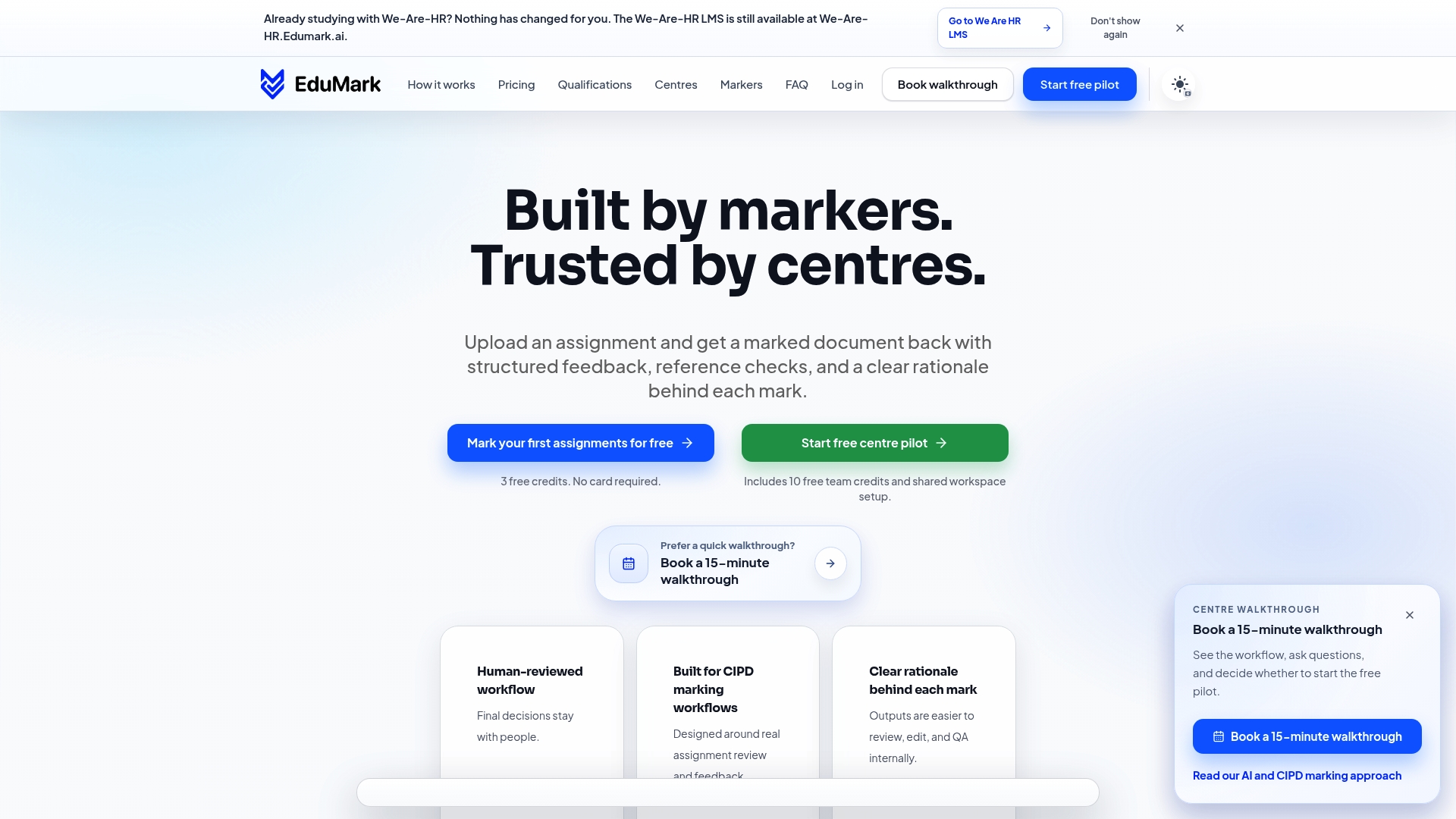
EduMark.ai embeds structured feedback, confidence scores, and audit trails directly into Word documents, so your evidence portfolio is compliance-ready from the moment marking is complete. Whether you are managing a high volume of CIPD submissions or preparing for an Ofsted ITE inspection, the platform scales to your needs with a credit-based model that keeps costs predictable. Responsible AI, human oversight, and regulatory alignment are built into every feature.
Frequently asked questions
Is there an official educator assessment checklist for 2026 in the UK?
No official 2026 checklist exists; Ofsted's ITE Toolkit and CIPD upgrade guides are the closest authoritative sources and should be used together to build a comprehensive framework.
How does AI impact educator assessment in 2026?
AI streamlines competency evaluation and marking consistency, but CIPD prohibits AI for assignment generation and requires transparent disclosure of any AI-assisted marking processes.
What evidence is required for CIPD upgrade assessment?
CIPD upgrade assessments require portfolio examples from the last five years, an updated CV, and clear evidence of measurable impact on people practices within your organisation.
Does Ofsted accept AI-only assessment evidence?
No; Ofsted evaluates provider decisions on AI use and requires evidence of learner impact, human oversight, and transparent data handling rather than AI-generated outputs alone.
Does CPD have minimum hours requirements in 2026?
England has no minimum hours requirement; Scotland requires 35 hours minimum, but both Ofsted and CIPD emphasise depth of learning and evidence of impact over the number of hours logged.
Recommended
- Best practices for CIPD assessors: quality and compliance
- CIPD assessment checklist: essential criteria and tools
- Assessment grading checklists for CIPD: boost accuracy
- Understanding regulatory standards for CIPD assessments in 2026
Sources & further reading
See how EduMark connects learning, assessment and your team.
Explore EduMark →