

TL;DR:
- Standardised marking criteria ensure consistency, fairness, and regulatory compliance in CIPD assessments.
- Developing clear rubrics involves defining observable descriptors for each grade level and calibrating assessors.
- Proper implementation balances standardisation with flexibility to recognize creativity and professional judgement.
Two equally capable learners submit work of comparable quality. One receives a Merit. The other scrapes a Pass. The difference? Which assessor happened to pick up their assignment. This scenario is more common in CIPD training centres than most would care to admit, and it represents a serious threat to assessment integrity. Standardised marking criteria exist precisely to close this gap. In this article, we examine why consistency matters, what standardisation actually involves, the measurable benefits it delivers, and the pitfalls to watch for when implementing it across your centre.
Table of Contents
- The need for consistency in CIPD assessment
- What does standardising marking criteria involve?
- Key benefits of standardised marking criteria
- Challenges, critiques, and practical recommendations
- A fresh perspective on standardising marking in CIPD centres
- Support for effective standardisation in your centre
- Frequently asked questions
Key Takeaways
| Point | Details |
|---|---|
| Promotes consistency | Standardised marking ensures similar performances are graded alike regardless of who marks them. |
| Supports fairness and compliance | Fixed criteria reduce bias and meet regulatory requirements for CIPD assessments. |
| Improves feedback quality | Clear rubrics let educators give students specific guidance for improvement. |
| Saves time and effort | A shared framework speeds up both marking and training for new assessors. |
The need for consistency in CIPD assessment
Inconsistent grading is not simply an administrative inconvenience. It undermines learner trust, exposes your centre to regulatory scrutiny, and calls into question the validity of every qualification you award. When two assessors interpret the same learning outcome differently, the result is a lottery rather than a fair evaluation. Across large cohorts, this variation compounds quickly.
Consider a CIPD Level 5 cohort with four assessors and sixty learners. Even modest differences in how each assessor interprets a criterion such as "critical analysis" can produce grade distributions that diverge significantly. Learners who receive lower grades may appeal, and if your moderation records cannot demonstrate a consistent standard, your centre is exposed.
"Standardised marking criteria enhance assessment consistency by reducing variation among multiple markers, ensuring the same work receives similar grades regardless of assessor."
Calibration and moderation protocols are the structural answer to this problem. Calibration involves assessors marking the same sample piece independently, then comparing outcomes and discussing discrepancies before the main marking round begins. Moderation involves a senior assessor reviewing a proportion of marked work to confirm standards have been applied uniformly. Together, these processes form the backbone of any credible standardisation strategy.
For CIPD centres specifically, the stakes are high. Qualifications at Levels 3, 5, and 7 carry professional weight in the HR and L&D sectors. Employers rely on them as signals of competence. If grading is inconsistent, that signal becomes noise. Reviewing your assessment checklist essentials is a practical starting point for identifying where your current process may be falling short.
The key benefits of consistent assessment are worth stating plainly:
- Fairness: Every learner is judged against the same standard, regardless of who marks their work.
- Trust: Learners, employers, and awarding bodies can rely on the grades awarded.
- Regulatory acceptance: Consistent records support successful external verification visits.
- Reduced appeals: Clear criteria give learners less grounds for dispute.
- Assessor confidence: Markers feel supported by clear guidance rather than left to interpret vague descriptors.
Following best practice for quality is not optional for centres serious about maintaining their approved status.
What does standardising marking criteria involve?
Standardised marking criteria are structured rubrics that define, in explicit terms, what a piece of assessed work must demonstrate to achieve each grade level. In CIPD contexts, this typically means specifying the qualities required for Pass, Merit, and Distinction across each assessment criterion.
Assessment criteria in CIPD qualifications provide clarity and transparency for students and educators on expected qualities for grade levels, serving as a blueprint against which work is judged. Without this blueprint, assessors default to their own professional intuition, which varies.
The contrast between subjective and standardised grading is stark:
| Factor | Subjective grading | Standardised grading |
|---|---|---|
| Consistency across assessors | Low | High |
| Learner clarity on expectations | Vague | Explicit |
| Time to reach grading decisions | Variable | Reduced |
| Grounds for appeals | Higher | Lower |
| Regulatory defensibility | Weak | Strong |
Constructing a robust rubric involves a clear sequence of steps. A well-designed CIPD grading guide will walk you through the process, but the core stages are:
- Identify the learning outcomes that the assessment is designed to measure.
- Define performance levels for each outcome, typically Pass, Merit, and Distinction.
- Write descriptors for each level using observable, measurable language.
- Pilot the rubric with a small sample of work and at least two assessors.
- Refine based on disagreements found during the pilot calibration session.
- Align descriptors with the relevant qualification standards and awarding body guidance.
Understanding the full range of assessment types available to CIPD centres also informs how rubrics should be adapted for different formats, whether written reports, case studies, or reflective accounts.
Pro Tip: Involve at least three assessors in your initial calibration session. Disagreements are not a problem; they are data. Each point of contention reveals an ambiguity in your descriptors that needs resolving before the rubric goes live.
Criteria must also be written in language that learners can understand. If a descriptor reads like internal jargon, it fails both the assessor and the learner it is meant to guide.

Key benefits of standardised marking criteria
The case for standardisation is not merely theoretical. The practical gains for CIPD training centres are measurable and significant.
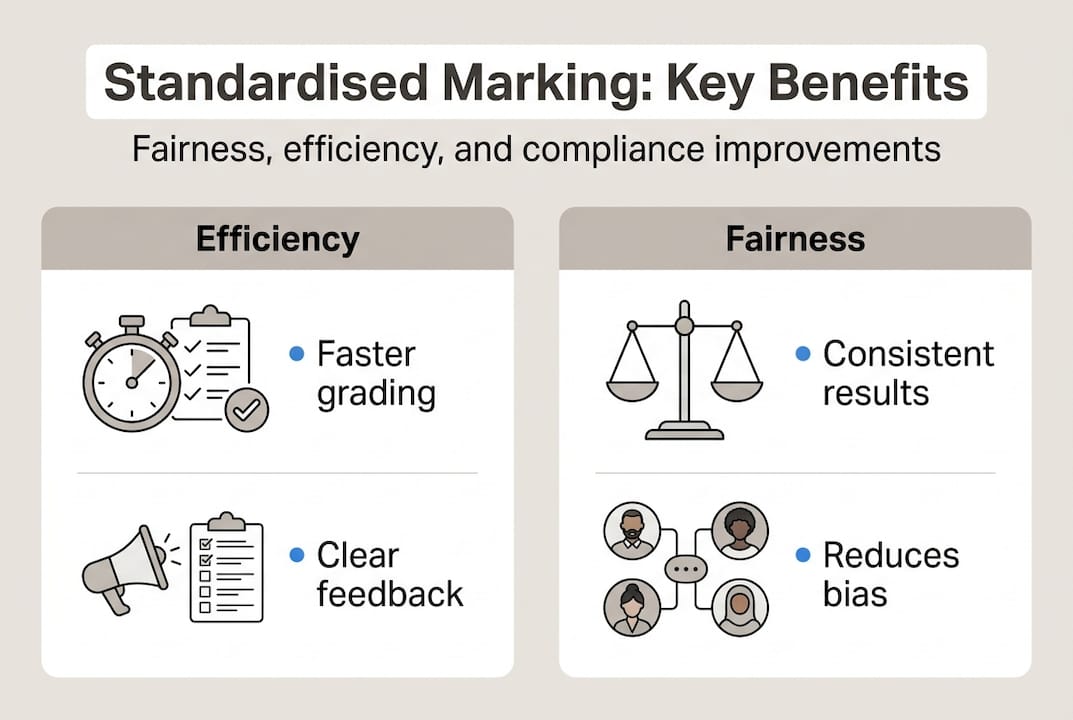
Standardisation improves efficiency by focusing efforts, saving time, and enabling constructive feedback linked to criteria. When assessors are not reinventing their interpretation of a criterion for each submission, marking becomes faster and more focused. Feedback quality also rises because assessors can point directly to specific descriptors rather than offering vague commentary.
Standardisation supports fairness, equity, and regulatory compliance by establishing consistent expectations and reducing bias. This is particularly important in diverse cohorts where unconscious bias can otherwise influence grading decisions in subtle ways.
Research indicates that standardised approaches can reduce grading gaps by as much as 25%, a meaningful reduction in a sector where grade boundaries carry real professional consequences.
The before-and-after picture for a centre adopting standardised criteria looks like this:
| Metric | Before standardisation | After standardisation |
|---|---|---|
| Inter-assessor variability | High | Low |
| Learner clarity on criteria | Poor | Strong |
| Average time to grade | Longer | Shorter |
| Appeal frequency | Higher | Lower |
| External verification outcomes | Inconsistent | Reliable |
Pro Tip: When writing grade descriptors, use action verbs tied to observable behaviours. "Critically evaluates" is measurable. "Shows understanding" is not. This small shift makes your accuracy grading checklists far more effective in practice.
Key compliance benefits also deserve attention:
- Alignment with Ofqual regulatory expectations for consistency and fairness.
- Documented evidence of standardisation supports external verification visits.
- Reduced risk of successful learner appeals against grade decisions.
- Clear audit trail demonstrating that assessment decisions are defensible.
For centres managing assessment moderation across multiple sites or assessors, standardised criteria are the single most effective tool for maintaining coherence at scale.
Challenges, critiques, and practical recommendations
Standardisation is not without its critics, and the concerns raised are worth taking seriously rather than dismissing.
One well-documented risk is that rigid rubrics can narrow what assessors look for, potentially overlooking genuinely innovative or creative responses that do not fit neatly into predefined descriptors. Over-reliance on standardised approaches may narrow curriculum focus and introduce judgment bias in comparative marking methods.
"While promoting equity and consistency, critics note standardised approaches may undervalue creativity and diversity in learner responses."
This tension is real. A learner who approaches a CIPD assignment in an unconventional but genuinely insightful way may find themselves penalised by a rubric that rewards a particular structure over original thinking. Assessors must retain the professional judgement to recognise and reward quality even when it arrives in unexpected forms.
Common errors to avoid when designing and implementing standardised criteria include:
- Writing descriptors that are so narrow they exclude valid alternative approaches.
- Failing to update rubrics when qualification standards or unit content changes.
- Not training all assessors on the rubric before marking begins.
- Using criteria language that learners cannot access or understand.
- Treating the rubric as a ceiling rather than a floor for what constitutes quality work.
A balanced implementation checklist should include regular rubric review cycles, structured calibration sessions at least once per assessment cycle, and a formal mechanism for assessors to flag cases where the rubric feels inadequate.
Pro Tip: Pair your standardised rubric with a formative feedback layer. Use the rubric for summative grading decisions, but supplement it with qualitative, narrative feedback that acknowledges the individual learner's approach. This is where your structured feedback guide becomes invaluable. Staying current with CIPD regulatory standards ensures your rubrics remain aligned with evolving awarding body expectations.
A fresh perspective on standardising marking in CIPD centres
Here is something that rarely gets said openly: the biggest risk with standardisation is not that it fails to work. It is that it works too well, and assessors stop thinking.
When a rubric is clear and well-constructed, there is a temptation to treat it as a mechanical checklist rather than a professional framework. Experienced assessors know that a Pass-level response can sometimes contain a genuinely brilliant insight that deserves acknowledgement, even if the overall submission does not reach Merit. Rubrics should sharpen judgement, not replace it.
The next decade of CIPD assessment should see flexible frameworks that reward both standardisation and individual growth. Automated assessment strategies now offer a way to handle the consistency layer efficiently, freeing senior assessors to focus their attention on the nuanced cases that genuinely require human expertise. That is the right division of labour. Use technology to enforce the standard. Use people to interpret it.
Support for effective standardisation in your centre
Standardisation is achievable, but it requires the right infrastructure. Without consistent tools and processes, even well-designed rubrics drift in application over time.

EduMark.ai is built specifically to support CIPD training centres in delivering standardised, AI-assisted marking at scale. The platform embeds structured criteria directly into the marking workflow, provides transparent rationale for every grade decision, and supports human review at every stage. If you are ready to operationalise what you have learnt here, start with our review checklist for compliance and explore how the EduMark platform can support your centre's assessment consistency goals today.
Frequently asked questions
How does marking standardisation improve fairness in assessments?
It ensures all learners are judged against the same criteria, which reduces unconscious bias and promotes equity across different assessors and cohorts.
Are standardised marking criteria mandatory for CIPD compliance?
Yes. Using fixed rubrics that align with regulatory standards such as Ofqual guidance is required to maintain assessment integrity and approved centre status.
Can too much standardisation reduce creativity in student work?
It can. Standardised approaches may undervalue creativity and diversity, so rubrics should be balanced with formative, qualitative feedback that recognises original thinking.
How does standardisation help with feedback for learners?
Clear criteria make it straightforward to give focused, actionable feedback because constructive feedback is linked directly to specific grade descriptors and learning outcomes.
Recommended
- CIPD assessment checklist: essential criteria and tools
- Educational assessment guide for efficient CIPD grading
- Best practices for CIPD assessors: quality and compliance
- Understanding regulatory standards for CIPD assessments in 2026
Sources & further reading
See how EduMark connects learning, assessment and your team.
Explore EduMark →