

TL;DR:
- Fair assessment ensures equal opportunities, account for individual needs, and rely on broad evidence and moderation.
- Effective processes include clear criteria, varied evidence, internal and external moderation, and proper documentation.
- Ongoing assessor training and professional dialogue are crucial for consistency and genuine fairness in evaluation.
Fair assessment is one of those concepts that almost everyone in education assumes they understand, yet in practice it creates real disagreement. Many educators equate fairness with consistency, but genuine fairness demands far more: it requires moderation, inclusive processes, and evidence gathered over time rather than a single snapshot. Prediction accuracy at cohort level is relatively reliable at KS4, yet for individual pupils the picture is far messier. This guide unpacks exactly what fair assessment means within UK and CIPD frameworks, examines the processes that underpin it, and offers practical guidance on how to implement it confidently at your centre.
Table of Contents
- Defining fair assessment in UK education
- Frameworks and processes for fairness: from classwork to moderation
- Addressing challenging cases: edge pupils, special circumstances, and adjustments
- The role of teacher expertise, CPD, and evidence-informed practice
- A fresh perspective: what most fair assessment guides overlook
- Implementing fair assessment: tools and support for your centre
- Frequently asked questions
Key Takeaways
| Point | Details |
|---|---|
| Fair assessment principles | Consistency, evidence-base, and moderation are essential for trust and reliability. |
| Moderation safeguards | Internal and external moderation help ensure assessments reflect national standards. |
| Special case inclusivity | Edge cases and reasonable adjustments are fully integrated to ensure fairness for all pupils. |
| Teacher expertise matters | Educator judgement and ongoing CPD are foundations for fair assessment practice. |
Defining fair assessment in UK education
At its core, fair assessment means every learner has an equal opportunity to demonstrate what they know and can do, measured against clearly defined criteria and free from undue bias. It is not the same as identical treatment. A learner with a visual impairment and a learner without one face different barriers, and genuine fairness accounts for that difference.
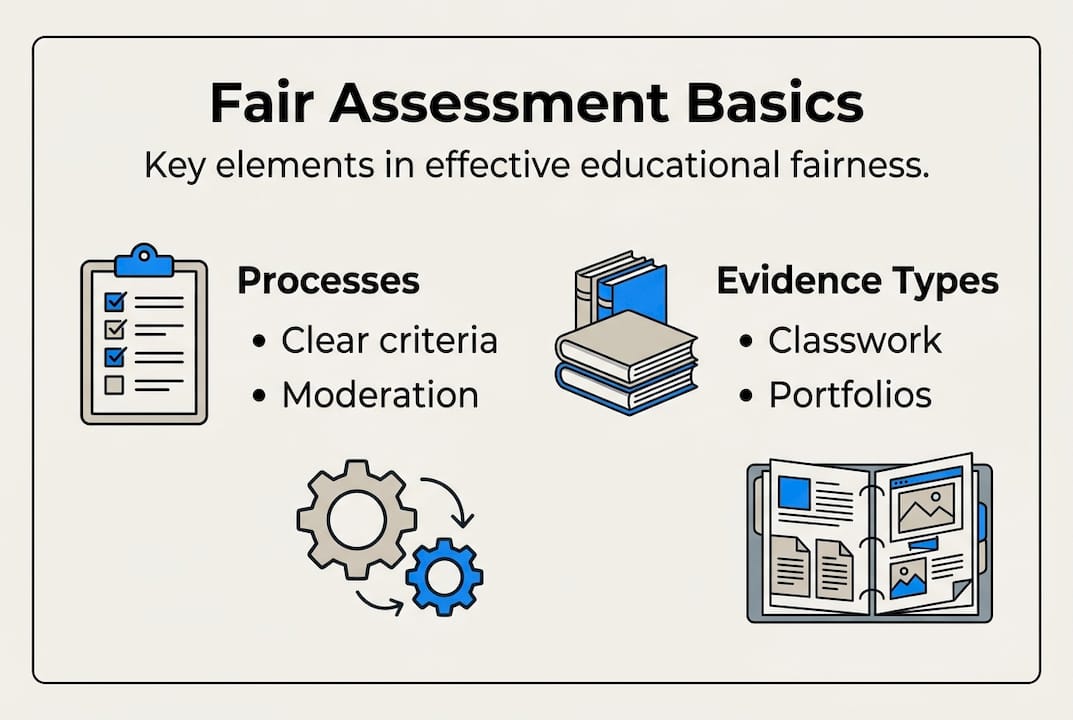
In UK educational contexts, particularly within CIPD qualification frameworks, fair assessment rests on four interlocking features:
- Objectivity: Marking is guided by published criteria, not personal impressions or assumptions about a learner's background.
- Evidence: Judgements draw on a broad range of work gathered over time, not just a single high-stakes piece.
- Moderation: Both internal and external checks review marking decisions to ensure consistency across assessors and centres.
- Inclusivity: Processes are designed so that adjustments can be made for learners who need them, without compromising the integrity of the assessment.
Fair practices involve broad evidence from classwork, "pupil can" statements, and internal and external moderation as statutory requirements. The statutory guidance makes clear that no single piece of work should be treated as definitive evidence on its own. That principle applies equally to CIPD assessments, where a portfolio or assignment submitted at the end of a unit should reflect consistent performance throughout the learning journey.
"Fair assessment is not about making things easier. It is about removing irrelevant barriers so that the assessment measures what it is actually supposed to measure."
The question of consistent assessment moderation is particularly relevant here. When multiple assessors work on the same cohort, without shared understanding of the criteria, variance creeps in. One assessor applies a generous interpretation of a competency statement; another applies a strict one. The learners bear the consequences of a disagreement they never knew was happening.
For assessment centre managers, the practical implication is this: fairness is not achieved once and then maintained automatically. It requires active, ongoing effort across every stage of the assessment cycle.
Frameworks and processes for fairness: from classwork to moderation
Knowing what fair assessment looks like in principle is one thing. Knowing how to build it into your processes is quite another. A well-structured assessment cycle moves through several distinct phases, each with its own quality checks.
- Setting criteria: Assessment criteria are written clearly, shared with learners in advance, and aligned to the relevant qualification standards.
- Evidence collection: Learners produce work across a range of tasks and contexts. Evidence is gathered over time rather than in a single sitting.
- Initial marking: Assessors apply the criteria consistently, recording rationale as they work through each submission.
- Internal moderation: A second assessor or internal moderator reviews a sample of marked work to check alignment with agreed standards.
- External moderation: An awarding body or external verifier reviews a further sample to confirm the centre is applying national standards correctly.
- Feedback and appeal: Learners receive structured feedback and have a clear route to query decisions they believe are unfair.
"Pupil can" statements, evidence over time, and regulatory moderation are all required components of a fair assessment system under UK statutory guidance. Skipping any of these steps introduces risk, both to individual learners and to the centre's relationship with the awarding body.
The difference between internal and external moderation is worth understanding clearly:
| Feature | Internal moderation | External moderation |
|---|---|---|
| Who conducts it | Centre staff, typically a senior assessor | Awarding body representative or external verifier |
| Primary purpose | Consistency between assessors within the centre | Alignment with national standards across centres |
| Frequency | Ongoing throughout the assessment cycle | At scheduled intervals, often annually or per cohort |
| Output | Internal standardisation records | External verification report |
Exploring the full range of types of educational assessments used across CIPD programmes can help centre managers map which moderation approach applies to each submission type.
Pro Tip: Run collaborative standardisation sessions before each new cohort begins marking. Bring assessors together to mark the same sample piece and then discuss their reasoning. This single step reduces assessor variance significantly and builds shared understanding of the criteria.
Addressing challenging cases: edge pupils, special circumstances, and adjustments
Fair assessment frameworks are designed with the typical learner in mind, but real cohorts are rarely typical. Assessment centre managers regularly encounter situations that fall outside the standard pathway, and handling them well is essential to maintaining integrity.
The main assessment pathways and how they differ are summarised below:
| Pathway | Who it applies to | Key process features |
|---|---|---|
| Main pathway | Most learners | Standard evidence, moderation, and reporting |
| Pre-key stage | Learners working below age-related expectations | Adapted standards, separate reporting codes |
| Absence or disapplication | Learners unable to complete assessment | Specific absence codes, no assessment outcome recorded |
| Special consideration | Learners affected by temporary circumstances | Documented adjustments, maintained evidence trail |
Pre-key stage assessments, codes for absent or disapplied students, and special adjustments are all part of a fair and compliant assessment system under UK statutory guidance. Each of these routes exists because forcing all learners through a single pathway would itself be unfair.
Reasonable adjustments are another area where documentation matters enormously. Common adjustments include:
- Extra time for learners with a diagnosed processing difficulty
- Rest breaks during timed assessments
- Use of assistive technology such as screen readers
- Adjusted formatting, for example larger font sizes or coloured overlays
- Oral assessment in place of written work, where permitted by the qualification
Every adjustment must be applied consistently and recorded thoroughly. If a learner later queries their outcome, or an external moderator asks how a decision was reached, the documentation is what protects both the learner and the centre. Using an educator assessment checklist can help you standardise how adjustments are requested, approved, and recorded across your team.
Pro Tip: Do not wait for a moderation visit to review your special consideration records. Schedule a quarterly internal audit of all adjustment decisions to catch inconsistencies before they become compliance issues.
The role of teacher expertise, CPD, and evidence-informed practice
Processes and frameworks only work when the people applying them have the knowledge and confidence to do so reliably. This is where continuous professional development becomes inseparable from fair assessment.

Teacher and assessor judgement sits at the heart of every fair assessment decision. The criteria may be clear, but applying them to a real piece of work, in context, for a specific learner, requires expertise that develops over time. No training programme creates that expertise overnight. It builds through practice, reflection, and structured opportunities to compare judgements with colleagues.
CPD frameworks stress curriculum alignment, evidence-informed practice, and educator expertise as the foundations of reliable assessment outcomes. Effective CPD for assessment practitioners typically includes:
- Regular standardisation and moderation exercises with clear feedback on decision-making
- Training on identifying and mitigating unconscious bias in marking
- Workshops on interpreting qualification criteria and applying them consistently
- Opportunities to review anonymised learner work across a range of performance levels
- Structured reflection on marking decisions, especially in borderline cases
"The assessor's professional judgement, informed by training and evidence, is what turns a set of criteria into a fair outcome for a real learner."
For CIPD assessment centres specifically, efficient CIPD grading practices and awareness of educational AI ethics are both increasingly relevant as new tools enter the marking workflow. Expertise is not static. As assessment contexts evolve, so must the professional knowledge that supports them.
Centres that invest consistently in assessor development tend to produce more reliable outcomes, generate fewer appeals, and build stronger relationships with awarding bodies. The return on that investment is measurable.
A fresh perspective: what most fair assessment guides overlook
Most guides on fair assessment focus on processes and tick-boxes. Get the criteria right, moderate thoroughly, document everything. That is all necessary, but it misses a harder truth: genuine fairness always involves trade-offs that no framework can fully resolve.
Standardisation and contextualisation pull in opposite directions. The more rigidly you standardise, the more you risk ignoring context that is actually relevant to a fair judgement. The more you contextualise, the more you risk introducing the kind of subjective variation that moderation is supposed to eliminate.
Fairness requires balancing high expectations with context, something Ofsted's evolving "similar schools" approach is beginning to grapple with at inspection level. That tension does not disappear at the assessment centre level. It just becomes your responsibility to manage it thoughtfully.
The best assessment centres we have seen treat moderation not as a compliance exercise but as an ongoing professional conversation. They use it to surface disagreement, interrogate assumptions, and refine shared understanding of what good work looks like. Reviewing assessment principles and AI integration alongside traditional moderation practices can sharpen that conversation further. Fair assessment is not a destination. It is a discipline.
Implementing fair assessment: tools and support for your centre
Building a fair assessment system is demanding work. It requires aligned processes, trained assessors, thorough documentation, and the capacity to handle complex cases without cutting corners. Many centres find that the administrative load of maintaining all of this at scale is where things start to slip.
EduMark.ai supports CIPD assessment centres with AI-assisted assignment marking that combines speed with structured, transparent feedback. Every mark comes with a clear rationale, inline comments, and confidence indicators, so your assessors can review, approve, and amend with confidence rather than starting from scratch. The platform is built with GDPR compliance and human oversight at its core, helping your centre maintain integrity while handling higher submission volumes. If fair, consistent, and efficient assessment is your goal, EduMark.ai is worth exploring.
Frequently asked questions
What are the main components of fair assessment?
Fair practices combine clear criteria, varied evidence, regular moderation, and adaptations for special cases to ensure reliability and inclusivity across all learners.
How are absent or disadvantaged pupils assessed fairly?
Specific codes, reasonable adjustments, and pre-key stage pathways adapt the assessment process for learners outside the standard route, as set out in statutory guidance.
Can moderation really ensure fairness?
Internal and external moderation together check consistency across assessors and centres, ensuring that national standards are applied reliably and that results can be trusted.
Why are teacher predictions sometimes inaccurate and what matters more?
Grade prediction accuracy varies significantly at the individual level, which is why robust evidence collection and structured moderation matter far more than any single prediction.
What role does CPD play in fair assessment?
CPD frameworks stress teacher expertise and collaborative moderation as the foundations that enable educators to design, implement, and moderate assessments reliably over time.
Recommended
- Educational assessment: principles, types, and AI integration
- Educational AI ethics explained: a UK assessor's guide
- Build a robust educator assessment checklist for CIPD compliance
- Best practices for CIPD assessors: quality and compliance
Sources & further reading
See how EduMark connects learning, assessment and your team.
Explore EduMark →