

TL;DR:
- Clear marking criteria focus on knowledge, application, and critical analysis for consistent grading.
- Command verbs like evaluate and analyse define the required cognitive level and must be accurately interpreted.
- AI tools support compliance and objectivity but should complement human judgment to ensure assessment integrity.
Ambiguous marking criteria do not just frustrate learners; they undermine the entire assessment process. When evaluators cannot clearly distinguish a Merit response from a Distinction, consistency collapses and learner trust erodes. This challenge has grown sharper as AI-assisted grading enters mainstream use across CIPD (Chartered Institute of Personnel and Development) qualification programmes. Assessment centres and training providers now face a dual obligation: apply rigorous, transparent criteria and ensure those criteria hold up under automated scrutiny. This article walks through practical marking criteria examples, grading tiers, command word compliance, and AI integrity safeguards, giving you a working framework you can apply immediately.
Table of Contents
- Core components of marking criteria for CIPD assignments
- Advanced marking criteria: Level 7 and high-stakes evaluation
- Critical analysis, evidence, and command word compliance
- AI-assisted marking: compliance and integrity safeguards
- A fresh perspective: what makes marking criteria genuinely effective?
- Connect with expert AI-assisted marking solutions
- Frequently asked questions
Key Takeaways
| Point | Details |
|---|---|
| Clear criteria foundation | Reliable marking begins with well-defined rubrics for CIPD assignments. |
| Advanced evaluation | Higher levels demand strategic, original responses and robust scoring methods. |
| Command word mastery | Understanding command verbs increases assignment success rates. |
| AI-integrated compliance | AI tools help ensure fairness and thorough reporting in grading processes. |
Core components of marking criteria for CIPD assignments
Every reliable CIPD marking rubric rests on three pillars. Understanding what each pillar demands, and how it is scored, is the first step toward consistent, defensible grading.
CIPD assignments are marked using a rubric with three main components: Knowledge and understanding, Application of knowledge, and Analysis and critical thinking, graded at Pass, Merit, or Distinction levels. Each component carries a different cognitive expectation. Knowledge and understanding tests whether a learner can accurately recall and explain concepts. Application shifts the expectation toward using those concepts in a realistic workplace context. Analysis and critical thinking demands that the learner interrogates assumptions, weighs evidence, and forms a reasoned judgement.
The three grading tiers work as follows:
- Pass: The learner meets the minimum threshold. Responses are accurate and relevant but may lack depth or real-world application.
- Merit: The learner demonstrates clear application of knowledge to practice, with some evaluative commentary supported by evidence.
- Distinction: The learner shows independent thinking, strategic insight, and robust critical analysis grounded in credible sources.
Consider a Level 5 assignment asking learners to explain the role of psychological safety in team performance. A Pass response defines the term and cites one model. A Merit response connects psychological safety to a specific organisational scenario. A Distinction response critiques competing models, references empirical research, and draws conclusions about strategic implications for people professionals.

Command verbs shape the cognitive level expected. Words such as describe invite factual recall. Analyse requires breaking a concept into parts and examining relationships. Evaluate demands a judgement supported by criteria and evidence. Markers who ignore these distinctions risk rewarding the wrong cognitive level, which distorts the entire grade distribution.
Pro Tip: Build a command verb glossary into your marking guidance documents. When markers share a common definition of evaluate, inter-rater reliability improves significantly. You can also cross-reference your rubric against a CIPD assessment checklist to confirm alignment before submission windows open.
Advanced marking criteria: Level 7 and high-stakes evaluation
At Level 7, the stakes and the nuance increase considerably. Generic rubrics that served well at Level 3 or Level 5 are insufficient here. Evaluators need a more granular framework.
For Level 7 units such as 7OS03, marking uses six criteria: focus, depth and breadth of understanding, strategic application, research and wider reading, persuasiveness and originality, and presentation and language. Grades are awarded as Pass (scoring 2 or more per learning outcome), Merit (10 to 13 total marks), and Distinction (14 to 16 total marks).
The table below illustrates how these score ranges translate across grading tiers:
| Grade | Total score range | Per learning outcome minimum |
|---|---|---|
| Pass | Up to 9 | 2 per LO |
| Merit | 10 to 13 | Consistent 3s across criteria |
| Distinction | 14 to 16 | 4s across most criteria |
Each of the six criteria deserves attention:
- Focus: Does the response directly address the question set?
- Depth and breadth: Does it cover the topic thoroughly without becoming superficial?
- Strategic application: Does the learner connect theory to senior-level organisational decisions?
- Research and wider reading: Are sources current, credible, and varied?
- Persuasiveness and originality: Does the learner present a distinctive, well-argued position?
- Presentation and language: Is the work professionally structured and clearly written?
A common pitfall at Level 7 is confusing description with evaluation. A learner who writes three paragraphs summarising Ulrich's HR model has demonstrated knowledge. A learner who critiques its applicability in a post-pandemic hybrid workforce, drawing on recent research, has demonstrated evaluation. The distinction matters enormously for efficient CIPD grading workflows, particularly when markers are processing high volumes.
Pro Tip: When moderating Level 7 scripts, use the six criteria as a checklist rather than a holistic impression. Score each criterion independently before arriving at a total. This approach, recommended in quality and compliance guidance, reduces the halo effect where one strong section inflates the overall grade.
Critical analysis, evidence, and command word compliance
The gap between a passing and a failing CIPD assignment often comes down to one thing: whether the learner analysed or merely described. This distinction is not semantic; it is structural.
CIPD marking emphasises critical analysis over description, application to real-world practice, evidence-based reasoning, and compliance with command words like evaluate and analyse. Markers who reward descriptive responses at the same level as analytical ones are, in effect, lowering the qualification standard.
Here is how command verbs map to cognitive expectations in practice:
- Describe requires the learner to give a clear account of features or characteristics. No judgement is needed.
- Explain requires the learner to clarify how or why something works. Cause and effect matter here.
- Analyse requires the learner to break a concept into components and examine how they interact.
- Evaluate requires the learner to make a supported judgement about value, effectiveness, or relevance.
- Critically evaluate requires the learner to weigh competing perspectives and reach a reasoned conclusion, acknowledging limitations.
"Misinterpreting command verbs is one of the most consistent causes of avoidable failure. A learner who describes when asked to evaluate has not met the learning outcome, regardless of how accurate their description is."
Misinterpreting command verbs such as confusing describe with evaluate leads directly to failure, and AI-generated content is increasingly flagged through automated detection reports. This creates a compounding risk: a learner who relies on AI to generate content may also inherit the AI's tendency toward descriptive rather than evaluative prose.
For markers, the practical implication is clear. When reviewing a response to an evaluate question, look for explicit judgements, referenced criteria, and acknowledgement of counter-arguments. If none of these are present, the response has not met the command word requirement, regardless of its factual accuracy. You can explore how AI ethics in assessment intersects with command word compliance, and how assessment principles and AI can be aligned to support fairer outcomes.
AI-assisted marking: compliance and integrity safeguards
The integration of AI into CIPD assessment workflows is no longer optional for many centres. It is a compliance requirement. Understanding what AI can and cannot do in this context is essential.
CIPD requires AI reports to be submitted alongside assignments. AI is inappropriate for generating submitted content but is permitted for research and idea generation. Violations are treated as malpractice. This policy places a clear boundary: AI supports the process, but the intellectual work must remain the learner's own.
For assessment centres, the compliance safeguards worth embedding into your workflow include:
- Objectivity checks: AI tools can flag inconsistencies in marking patterns across a cohort, identifying where one marker applies stricter standards than another.
- Malpractice detection: Automated reports highlight AI-generated passages, unusual citation patterns, and similarity scores against published sources.
- Fairness auditing: AI systems can track grade distributions by cohort, surfacing potential bias in marking decisions before moderation.
- Audit trails: Digital marking platforms generate timestamped records of every grading decision, supporting internal and external quality assurance.
Approximately 30% of first-submission CIPD assignments fail due to over-description rather than analysis or evidence-based reasoning. This is a preventable failure mode. When AI tools flag responses that are predominantly descriptive, markers can intervene earlier in the feedback cycle, reducing resubmission rates and administrative burden.
Effective assessment centres prioritise clear rubrics, objectivity, and fairness as foundational practices. AI-assisted platforms extend these principles at scale, enabling consistent application of criteria across hundreds of submissions simultaneously.
Pro Tip: Before opening a marking window, run a calibration exercise using AI-flagged sample scripts. When markers review the same AI-generated compliance report together, they align faster on borderline cases. Explore how accurate AI grading works in practice and review AI feedback reliability standards to ensure your platform meets current expectations.
A fresh perspective: what makes marking criteria genuinely effective?
Here is something the marking guidance documents rarely say plainly: rubrics can become a liability when they replace thinking rather than support it.
Tick-box marking, where evaluators score against criteria mechanically without engaging with the quality of reasoning, produces grades that are technically defensible but educationally hollow. A learner can score a Merit by hitting every criterion at a surface level while producing work that lacks genuine insight. That outcome serves nobody.
The most effective marking criteria we have seen share one quality: they are adaptive. They describe cognitive behaviours rather than content categories, which means they remain valid across different assignment topics and cohorts. They also leave room for professional judgement, recognising that a marker's contextual knowledge adds value that no algorithm can replicate.
AI brings real strengths: speed, objectivity, and pattern recognition at scale. But it works best as a first pass, not a final word. Human reviewers add the contextual nuance that distinguishes a technically correct response from a genuinely excellent one. The goal is not to replace that judgement but to protect the time and energy needed to exercise it well. Staying current with regulatory standards in 2026 ensures your criteria evolve alongside the qualification landscape rather than falling behind it.
Connect with expert AI-assisted marking solutions
If your centre is managing growing submission volumes while maintaining marking consistency and compliance, the operational pressure is real. Clear criteria are necessary, but they are not sufficient without the right tools to apply them reliably at scale.
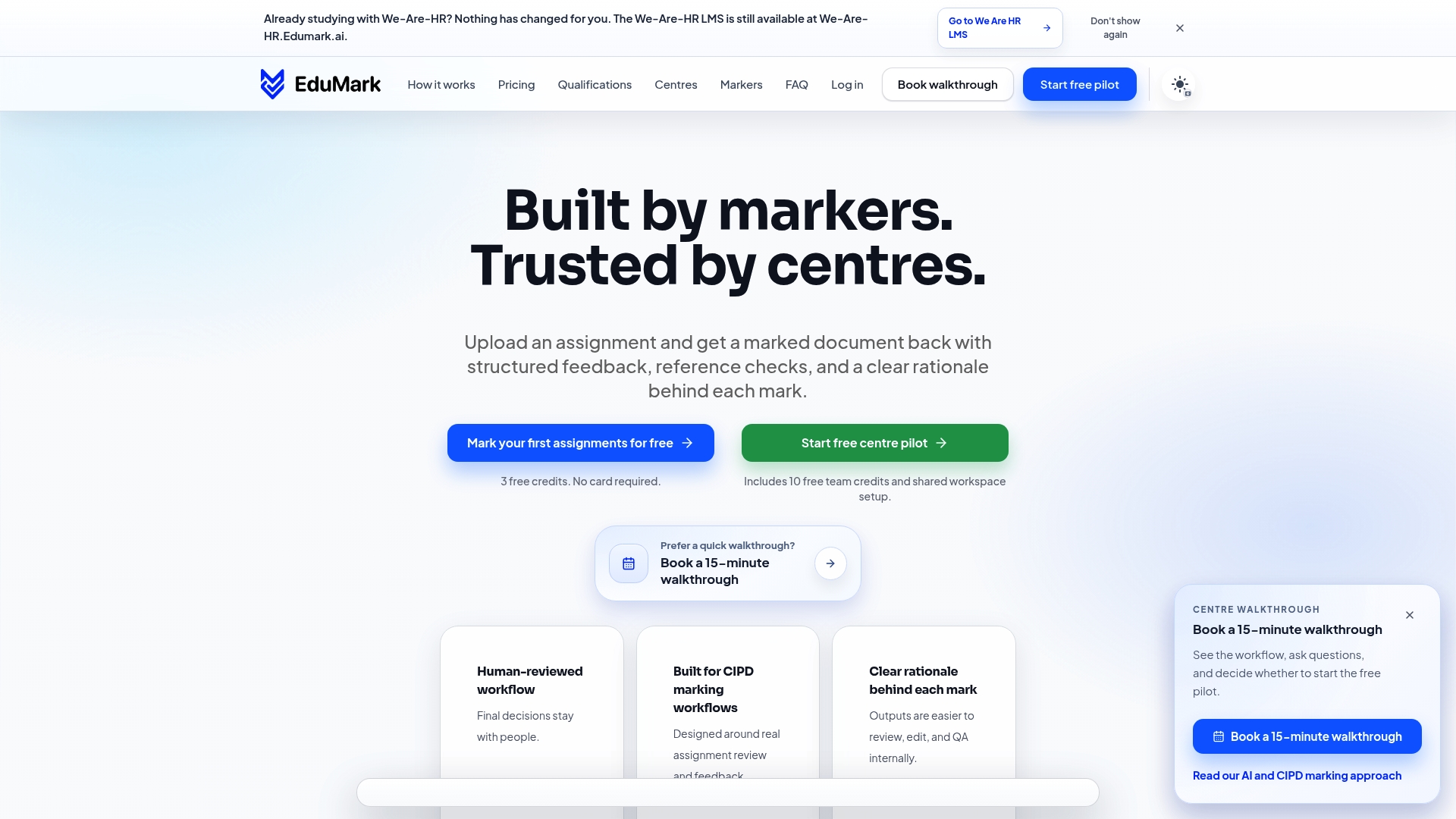
EduMark's AI-assisted CIPD marking platform is built specifically for this challenge. It automates criteria checking, generates structured feedback with transparent rationale, and produces compliance reports aligned with CIPD integrity policies. Every mark comes with an audit trail, inline comments, and a confidence score, all embedded directly into Word documents for seamless reviewer access. Human oversight remains central throughout. If you are ready to improve marking accuracy, reduce turnaround times, and strengthen your quality assurance process, EduMark is designed for exactly that.
Frequently asked questions
What are the main marking criteria used in CIPD assignments?
The chief criteria are knowledge and understanding, application of knowledge, and critical analysis, graded at Pass, Merit, or Distinction levels. Each criterion reflects a distinct cognitive expectation that markers must apply consistently.
How does AI influence the CIPD marking process?
AI tools are used for detection, reporting, and compliance checks within the marking workflow. CIPD policy is clear that AI must not generate submitted content, and violations are treated as malpractice.
What is the significance of command verbs in marking?
Command verbs such as evaluate or analyse determine the expected cognitive depth of a response. Compliance with command words is a core marking criterion, and responses that ignore the command verb cannot achieve higher grades regardless of content quality.
Why do many CIPD assignments fail on first submission?
Nearly 30% of first submissions fail because learners produce descriptive responses rather than analytical or evidence-based ones. Addressing this pattern early through structured feedback significantly reduces resubmission rates.
Recommended
- CIPD assessment checklist: essential criteria and tools
- Educational assessment guide for efficient CIPD grading
- Best practices for CIPD assessors: quality and compliance
- Types of educational assessments: a guide for CIPD leaders
Sources & further reading
See how EduMark connects learning, assessment and your team.
Explore EduMark →