

TL;DR:
- Feedback in CIPD is a strategic, ongoing component of all assessment and development processes.
- Effective feedback is timely, specific, actionable, and personalized to ensure candidate growth.
- Centres that prioritize quality feedback improve pass rates, candidate engagement, and organizational impact.
Feedback in CIPD is widely misunderstood as a corrective measure applied only when something goes wrong. In reality, it is a strategic driver embedded across every stage of the qualification and professional development journey. Whether you are managing assignment turnarounds, supporting candidates through referrals, or guiding practitioners toward chartered status, feedback shapes outcomes in ways that go far beyond a simple pass or fail. Performance management at CIPD level treats feedback as central to appraisals, reviews, and ongoing development processes. This article unpacks how structured feedback mechanisms work, why they matter, and what training centres can do to make them genuinely effective.
Table of Contents
- The foundational role of feedback in CIPD assessments
- Structured feedback mechanisms: tools and methodology
- Feedback in referrals, resubmissions, and membership upgrades
- Feedback and continuous professional development (CPD))
- What most CIPD providers miss about feedback effectiveness
- Enhance your feedback processes with EduMark
- Frequently asked questions
Key Takeaways
| Point | Details |
|---|---|
| Strategic value | Feedback drives employee growth and impacts performance in every CIPD assessment process. |
| Structured tools | Using digital platforms and reflective records ensures feedback is actionable and specific. |
| Improvement pathways | Timely, targeted feedback enables candidates to refine resubmissions and succeed in upgrades. |
| CPD integration | Feedback is essential to continuous professional development and measurable learning transfer. |
The foundational role of feedback in CIPD assessments
Feedback is not an add-on in CIPD processes. It is woven into the fabric of how qualifications are delivered, how professionals develop, and how organisations measure the impact of learning. Training centres that treat feedback as a box-ticking exercise are missing a significant opportunity to improve candidate outcomes and retention.
At its core, CIPD performance management uses feedback to drive employee development and align individual performance with organisational goals. This same principle applies directly to qualification assessments, where feedback helps candidates understand not just what they got wrong, but why and how to improve.
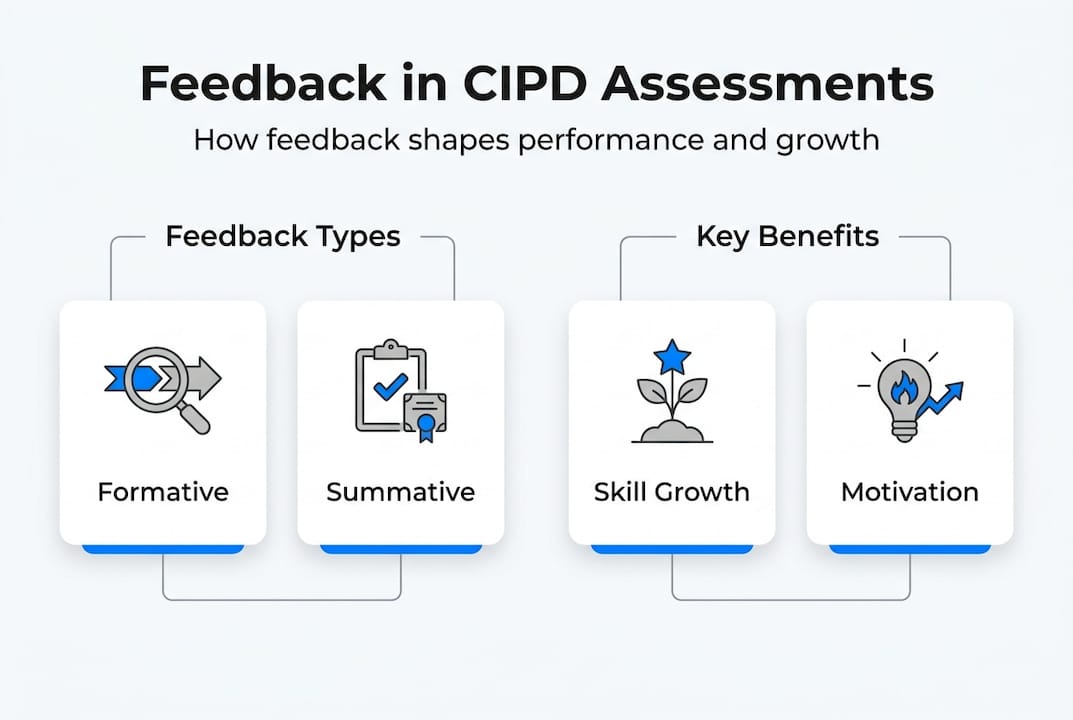
The evidence is compelling. The CIPD Good Work Index 2025 shows that employee voice and manager feedback correlate directly with better performance, improved mental health, and stronger retention. These findings are not limited to the workplace. They translate directly into assessment environments, where candidates who receive clear, timely feedback are more likely to persist, resubmit successfully, and ultimately achieve their qualification goals.
For CIPD training centres, this means feedback must be:
- Timely: delivered within agreed turnaround windows to maintain candidate momentum
- Specific: addressing precise gaps in knowledge or application, not vague generalities
- Actionable: giving candidates a clear path forward, not just a summary of shortcomings
- Fair: consistent across all assessors and aligned to published marking criteria
"Feedback that is generic, delayed, or inconsistent does not just frustrate candidates. It actively undermines their confidence and reduces the likelihood of a successful resubmission."
Understanding compliance feedback in CIPD is equally important, particularly as regulatory expectations around assessment integrity continue to evolve. Centres that embed best feedback practices into their workflows from the outset are far better positioned to deliver consistent, high-quality outcomes at scale.
Now that the importance of feedback is clear, let us look at how it is actually implemented within CIPD assessment processes.
Structured feedback mechanisms: tools and methodology
Structured feedback does not happen by accident. It requires deliberate tools, clear methodologies, and a shared understanding of what good feedback looks like in practice.
CIPD's My CPD Records tool is one of the most visible examples of structured feedback in action. CPD audits involve submitting reflective records through this platform, with feedback provided on the quality and impact of learning activities, all aligned to the CIPD Profession Map standards. This is not a passive review process. Assessors are expected to engage meaningfully with each submission, identifying where reflection is superficial and where genuine learning transfer is evident.
For qualification assessments, the picture is similar. Structured feedback on assignments includes specific guidance for resubmissions, such as requirements to personalise answers and move beyond descriptive responses toward analytical application.
| Feedback type | Purpose | Key feature |
|---|---|---|
| CPD audit feedback | Validates reflective quality | Aligned to Profession Map |
| Assignment feedback | Guides resubmission | Specific improvement actions |
| Referral feedback | Clarifies failure reasons | Actionable next steps |
| Upgrade assessment feedback | Supports chartered status | Demands real impact evidence |
The most effective feedback mechanisms share three characteristics. They are personalised to the individual candidate's submission, not copied from a template. They reference specific sections of the work rather than offering sweeping judgements. And they provide a clear, realistic route to improvement.
Pro Tip: When designing your feedback workflows, map each feedback type to the relevant stage of the CIPD Profession Map and CPD cycle. This ensures your commentary is not just accurate but genuinely developmental, giving candidates a framework they can act on immediately.
For a deeper look at how to build these workflows, the structured feedback guide from EduMark.ai offers practical frameworks tailored to CIPD contexts. You can also explore effective feedback in CIPD for current best practice guidance.
Feedback in referrals, resubmissions, and membership upgrades
When a candidate receives a referral, the quality of the feedback they receive at that moment is arguably the most important factor in determining whether they succeed on resubmission. Poor feedback at this stage leads to repeated failures, candidate disengagement, and reputational risk for the training centre.

For CIPD membership upgrades, the stakes are even higher. Chartered Member written assessments require candidates to demonstrate tangible work impact, and feedback after an unsuccessful attempt must guide them toward using recent, specific evidence rather than generic descriptions of their role.
Here is how feedback should function at each stage of the referral and upgrade process:
- Identify the specific gap: Feedback must name the exact criterion that was not met, not simply state that the response was insufficient.
- Distinguish description from application: Many candidates describe what they did rather than analysing why it mattered. Feedback must make this distinction explicit.
- Set clear parameters for resubmission: Resubmission requirements include using examples from the last five years, demonstrating honest reflection, and showing real business impact.
- Limit resubmission attempts: Candidates need to understand that resubmissions are not unlimited, which makes the quality of feedback even more critical.
- Acknowledge strengths: Effective feedback does not only address weaknesses. Recognising what the candidate did well builds confidence and provides a foundation for improvement.
| Stage | Feedback focus | Common pitfall |
|---|---|---|
| Initial referral | Gap identification | Vague or generic commentary |
| Resubmission guidance | Application over description | Repeating the same feedback |
| Membership upgrade | Real impact evidence | Accepting outdated examples |
Exploring assessment types and feedback helps centres understand the different demands placed on feedback at each level. An assessment checklist in CIPD can also help assessors ensure nothing critical is missed during the feedback process.
Feedback and continuous professional development (CPD)
Feedback does not stop at the end of an assessment. For CIPD practitioners, it is a continuous thread running through every stage of the CPD cycle: identify, plan, learn, reflect/record, and apply/share.
CIPD recommends 30 hours of planned CPD annually, with the CPD cycle designed to emphasise feedback loops at every stage. The reflect/record phase in particular depends entirely on the quality of feedback received, both from assessors and from the practitioner's own honest self-evaluation.
For training centres, this creates a clear responsibility. Your feedback does not just help a candidate pass an assessment. It shapes how they think about their own development for years to come.
Feedback supports CPD in the following ways:
- At the identify stage: Feedback from previous assessments highlights development needs and informs learning priorities
- At the plan stage: Specific feedback helps practitioners choose the right CPD activities to address identified gaps
- At the reflect/record stage: Assessor commentary models the kind of critical reflection that strong CPD records require
- At the apply/share stage: Feedback on impact evidence encourages practitioners to connect learning to real organisational outcomes
Key insight: L&D evaluation research shows that feedback directly measures learning transfer and bridges performance gaps, supporting alignment with business objectives. Centres that build feedback loops into their CPD support are not just improving pass rates. They are contributing to measurable business impact for their learners' organisations.
Improving grading accuracy in CIPD and investing in assessment moderation in CIPD are two practical steps that reinforce the feedback loop across your entire assessment operation.
What most CIPD providers miss about feedback effectiveness
Here is something most centres do not want to hear: the majority of feedback given in CIPD assessments is technically correct but practically useless. It tells candidates what went wrong without giving them the cognitive tools to understand why or how to fix it.
Generic feedback erodes motivation faster than a failed grade. When a candidate reads "needs more analysis" for the third time without any explanation of what analysis actually looks like in their specific context, they do not improve. They disengage.
Timely, specific feedback is empirically shown to drive real improvement, yet many centres still rely on templated commentary that saves assessor time at the cost of candidate progress. The irony is that poor feedback generates more resubmissions, more moderation queries, and ultimately more assessor workload, not less.
The centres that consistently achieve high first-time pass rates and strong candidate satisfaction scores share one habit: they treat feedback as a teaching tool, not an administrative output. They invest in assessor training, build structured feedback templates that allow for personalisation, and review feedback quality as part of their internal moderation process. Effective feedback strategies are not complicated. They are simply applied consistently.
Enhance your feedback processes with EduMark
If your centre is ready to move beyond templated commentary and build a feedback process that genuinely improves candidate outcomes, EduMark.ai was built with exactly that challenge in mind.
The EduMark assessment platform supports CIPD training centres with AI-assisted marking workflows that deliver structured, specific, and consistent feedback at scale. From inline comments embedded directly into Word documents to confidence checks and transparent rationale behind every mark, EduMark helps your assessors spend less time on administration and more time on the feedback that actually matters. Whether you are managing five submissions a month or five hundred, AI feedback tools for CIPD can help your centre improve accuracy, support compliance, and reduce turnaround times without compromising quality.
Frequently asked questions
How is feedback typically delivered in CIPD assessments?
Feedback is given via digital platforms, structured records, and written comments on assignments. Referral feedback includes specific guidance such as personalising answers and moving beyond descriptive responses.
Why is feedback important for CIPD membership upgrades?
Feedback identifies gaps in impact examples and guides candidates to use recent, specific evidence for resubmissions. Chartered Member assessments require demonstrable work impact, making precise feedback essential.
What is the CIPD CPD cycle and how does feedback fit in?
The CPD cycle covers identify, plan, learn, reflect/record, and apply/share. Feedback is vital at the reflect/record stage, closing the loop for continual improvement and informing future learning priorities.
How does feedback influence learning transfer in CIPD L&D?
Feedback directly measures whether learning has transferred into practice. L&D evaluation research confirms it bridges performance gaps and supports alignment with business objectives and real organisational impact.
Recommended
- Ensure compliance with assessment feedback in CIPD qualifications
- Best practices for CIPD assessors: quality and compliance
- How to provide assessment feedback effectively in 2026
- Structured assessment feedback guide for CIPD educators
Sources & further reading
See how EduMark connects learning, assessment and your team.
Explore EduMark →