

Delivering clear, actionable feedback on CIPD assessments remains one of the most challenging tasks for assessment coordinators and educators. Many struggle to balance honesty with encouragement, often defaulting to vague praise that leaves learners confused about how to improve. This guide walks you through proven structured methods, including the R2C2 model and staged feedback processes, to help you deliver transparent, development-focused feedback that builds learner confidence and meets regulatory standards. You will learn preparation steps, execution techniques, and troubleshooting strategies to transform your feedback delivery in 2026.
Table of Contents
Key takeaways
| Point | Details |
|---|---|
| Structured models work | Using frameworks like R2C2 reduces ambiguity and promotes clearer learner understanding. |
| Preparation matters | Knowing criteria, arranging private settings, and building rapport before feedback enhances effectiveness. |
| Honesty drives growth | Addressing underperformance with specific examples and action plans supports genuine development. |
| Mix formats strategically | Combining oral dialogue with written notes deepens understanding and provides reference points. |
Understanding the importance of structured feedback
Structured feedback ensures clarity and transparency in assessment outcomes, helping learners understand exactly where they excelled and where improvement is needed. Without a clear framework, feedback sessions often devolve into uncomfortable exchanges filled with ambiguous statements like “good effort” or “needs work,” which provide no actionable guidance. Structured models like R2C2 provide frameworks that reduce ambiguity and promote learner growth by breaking feedback into manageable stages.
When you adopt a structured approach, you create consistency across all your assessments. Learners begin to recognise patterns in how feedback is delivered, which builds trust in the process and makes them more receptive to constructive criticism. This consistency also protects you as an educator, providing a defensible rationale for grades and recommendations that aligns with CIPD standards and regulatory requirements.
Common pitfalls undermine even well-intentioned feedback efforts:
-
Vague praise that sounds positive but offers no specific guidance
-
Overly critical comments without balanced recognition of strengths
-
Generic statements that could apply to any learner regardless of performance
-
Feedback delivered in rushed or public settings that prevent honest dialogue
Building rapport with learners facilitates open, constructive dialogue. When learners feel respected and understood, they are far more likely to engage with difficult feedback rather than becoming defensive. A few minutes spent establishing connection at the start of a feedback session pays dividends throughout the conversation. This rapport transforms feedback from a one-way judgement into a collaborative exploration of development opportunities.
AI-assisted marking for CIPD assessments can support this structured approach by providing consistent initial evaluations that human markers then refine and contextualise. The combination ensures both efficiency and the personal touch that effective feedback requires.
Pro Tip: Before any feedback session, write down three specific examples from the learner’s work, one strength and two development areas, to anchor your conversation in concrete evidence rather than general impressions.
Preparing to provide assessment feedback
Thorough preparation separates effective feedback from wasted opportunities. You must know the assessment criteria and the learner’s performance in detail before entering any feedback conversation. This means reviewing the submission multiple times, checking it against marking rubrics, and noting specific passages or sections that illustrate key points. Surface-level familiarity will be obvious to learners and undermines your credibility.
Arrange a private, uninterrupted setting to build trust and rapport first. Feedback delivered in corridors or shared offices lacks the psychological safety needed for honest exchange. Choose a quiet room, silence notifications, and allocate sufficient time so neither you nor the learner feels rushed. The 4-stage feedback preparation process emphasises building rapport as the essential first stage before discussing performance.
Your preparation checklist should include:
-
Review the learner’s submission against all assessment criteria
-
Identify three to five specific strengths with evidence from their work
-
Note three to five development areas with concrete examples
-
Prepare constructive suggestions for each development area
-
Anticipate potential emotional reactions and plan empathetic responses
-
Gather any supporting materials like rubrics or exemplar work
Prepare constructive comments balancing strengths and areas for development. Research shows that feedback perceived as unfairly negative or unrealistically positive both fail to drive improvement. Aim for a ratio that honestly reflects performance while maintaining learner motivation. For struggling learners, this might mean highlighting smaller wins alongside necessary criticism. For high performers, it means pushing them toward excellence rather than settling for comfortable competence.
Gather evidence and examples to support your points during the session. Vague statements like “your analysis was weak” provide no actionable guidance. Instead, prepare to say “in paragraph three, you asserted that motivation drives retention without citing supporting research or considering alternative factors like compensation.” This specificity makes feedback undeniable and actionable.
Pro Tip: Create a simple template for your preparation notes with sections for strengths, development areas, evidence, and suggested actions, then reuse this structure for every feedback session to build consistency and save time.
Preparing CIPD assessment feedback becomes more efficient when you use tools that highlight patterns across multiple submissions, allowing you to focus your preparation time on the unique aspects of each learner’s work.
Executing effective feedback delivery
The delivery process transforms your preparation into learner development. Begin with rapport by acknowledging the learner’s effort and asking open questions about their experience completing the assessment. This opening phase should feel conversational rather than interrogative. Simple questions like “how did you find this assignment?” or “which sections felt most challenging?” invite dialogue and reveal the learner’s self-awareness.
Invite learner reactions and perceptions honestly. The R2C2 model’s second stage focuses on understanding the learner’s own view of their performance before you share yours. This approach uncovers misunderstandings early and shows respect for the learner’s perspective. You might discover they are already aware of weaknesses you planned to address, which changes how you frame that feedback.
Follow these execution steps for structured delivery:
-
Establish rapport and set a collaborative tone
-
Invite the learner to share their self-assessment first
-
Acknowledge accurate self-perceptions and gently correct misunderstandings
-
Present your feedback starting with specific strengths
-
Transition to development areas using concrete examples
-
Collaborate on action plans for each development area
-
Summarise agreements and confirm understanding
-
Schedule follow-up if needed for complex issues
Clarify misunderstandings and coach for positive change and development plans. When learners misinterpret assessment criteria or their own performance, use this as a teaching moment rather than simply correcting them. Explain the reasoning behind your evaluation, reference the rubric, and show how their work maps to different achievement levels. This educational approach builds assessment literacy alongside subject knowledge.
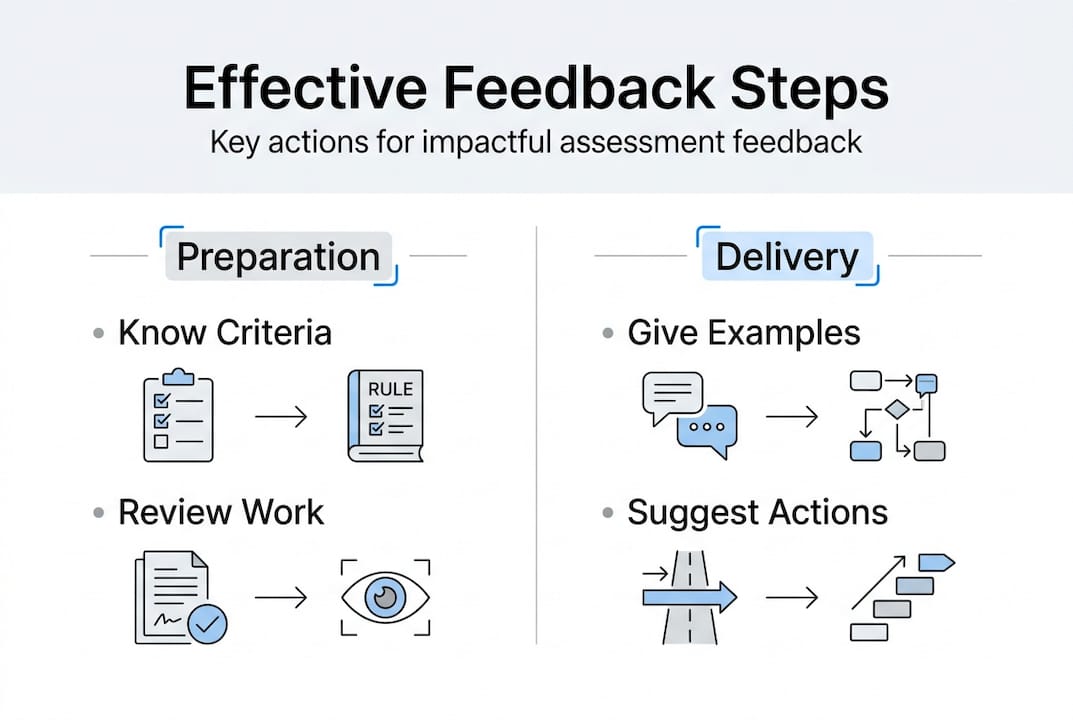
Mixed oral and written feedback creates dialogic depth and provides reference points learners can revisit. During your conversation, take notes on key points and agreements, then provide a written summary afterward. This dual approach accommodates different learning preferences and creates accountability for action plans.
Address underperformance with specific examples and clear action steps. Difficult conversations become necessary when learners fail to meet standards. Avoid softening the message so much that its seriousness is lost, but maintain empathy throughout. State the performance gap clearly, provide evidence, explain consequences, and collaborate on a concrete improvement plan with deadlines.
| Feedback stage | Key actions | Common mistakes |
|---|---|---|
| Rapport building | Ask open questions, acknowledge effort | Rushing to judgement, seeming distracted |
| Perception sharing | Listen actively, validate accurate views | Dismissing learner perspective, interrupting |
| Understanding | Clarify criteria, provide evidence | Using jargon, making assumptions |
| Coaching | Collaborate on actions, set timelines | Prescribing solutions, avoiding specifics |
Conclude feedback with summarised agreements and encourage questions. Repeat the key development priorities and action steps to confirm shared understanding. Ask the learner to articulate their next steps in their own words, which reveals any remaining confusion and reinforces commitment.
Pro Tip: After delivering difficult feedback, pause for five seconds before moving on, this silence gives learners space to process emotions and formulate questions they might otherwise suppress.
Effective CIPD feedback delivery benefits from consistent documentation that tracks learner progress over time, helping you identify patterns and adjust your approach for maximum impact.
Common challenges and troubleshooting tips
Vague praise that lacks actionable value prevents learner confusion only if you replace it with specificity. Statements like “well done” or “excellent work” feel good momentarily but provide no guidance for maintaining or improving performance. Instead, identify exactly what made the work successful. Say “your application of Maslow’s hierarchy to the case study demonstrated sophisticated analysis because you considered cultural context and individual differences.”
Prepare for emotional reactions by staying calm and empathetic. Some learners respond to critical feedback with tears, anger, or withdrawal. Your role is to acknowledge these emotions without being derailed by them. Phrases like “I can see this is difficult to hear” or “it’s natural to feel disappointed” validate feelings while keeping the conversation productive. Offer a brief pause if needed, but return to the substantive discussion.
Troubleshooting strategies for common scenarios:
-
Defensive learners: Ask them to explain their reasoning before you challenge it, often they will identify flaws themselves
-
Overconfident learners: Use comparison with exemplar work to reveal gaps objectively
-
Disengaged learners: Connect feedback to their stated career goals to rebuild relevance
-
Repeat underperformers: Escalate to formal improvement plans with clear consequences
Use clear language and examples to reduce misunderstandings. Educational jargon and assessment terminology confuse learners who lack your expertise. When you must use technical terms, define them immediately with concrete examples. Instead of saying “your critical evaluation lacked depth,” explain “you described the theory but didn’t analyse its limitations or compare it with alternative approaches.”
Handling underperformance requires difficult conversations and action plans while avoiding overly positive or nonspecific feedback that masks serious issues. Document these conversations carefully, noting what was discussed, agreed actions, and deadlines. This documentation protects both you and the learner if performance issues persist.
Create follow-up plans for continuous improvement and accountability. Feedback should never be a single isolated event. Schedule check-ins to review progress on action plans, celebrate improvements, and adjust strategies if initial approaches are not working. This ongoing engagement signals your investment in the learner’s success and prevents them from feeling abandoned after receiving criticism.
Pro Tip: Keep a simple tracking spreadsheet with learner names, feedback dates, key development areas, and follow-up dates, this system ensures no one falls through the cracks and helps you spot patterns across your cohort.
Troubleshooting CIPD feedback challenges becomes easier when you have access to historical data showing how similar issues were addressed successfully in previous assessments.
Discover AI-assisted feedback tools for CIPD assessments
Transforming your feedback delivery in 2026 requires both refined technique and smart tools. EduMark’s platform offers AI-driven support to ease the marking process, providing consistent initial evaluations that you can refine with your expertise and contextual understanding. The system improves consistency and transparency in feedback for CIPD assessments by highlighting patterns, suggesting evidence-based comments, and ensuring all criteria are addressed systematically.
The platform integrates well with structured feedback methods like R2C2, allowing you to focus your time on the high-value interpersonal aspects of feedback delivery rather than administrative marking tasks. Designed specifically for markers and CIPD training centres in 2026, AI-assisted CIPD assignment marking maintains human oversight while dramatically reducing turnaround times and improving marking accuracy across your team.
How to provide assessment feedback FAQ
What is the best time to provide assessment feedback?
Provide feedback within two weeks of submission while the work remains fresh in the learner’s mind. Immediate feedback maximises learning impact, but allow yourself sufficient time for thorough review rather than rushing to meet arbitrary deadlines.
How do I handle emotional reactions during feedback sessions?
Acknowledge emotions calmly without being derailed by them, use phrases like “I understand this is difficult” and offer a brief pause if needed. Return to substantive discussion once the learner has regained composure, maintaining empathy throughout.
Should feedback be primarily oral or written?
Combine both formats for maximum effectiveness. Oral feedback enables dialogue and immediate clarification, while written feedback provides a reference document learners can revisit when implementing improvements.
How specific should feedback comments be?
Every comment should reference specific examples from the learner’s work with enough detail that they can locate the relevant section. Vague generalisations provide no actionable guidance and waste everyone’s time.
What if a learner disagrees with my assessment?
Invite them to explain their perspective fully, then reference the assessment criteria and rubric to show how their work maps to different achievement levels. Use exemplar work for comparison if disagreement persists, focusing on objective standards rather than subjective opinions.
How do I balance honesty with maintaining learner motivation?
Honesty and motivation are not opposites. Learners respect candid feedback when it is delivered with empathy, supported by evidence, and accompanied by concrete action plans. False praise undermines motivation by creating confusion and distrust.