

Finding the right tool for your online teaching needs can feel like solving a puzzle with many pieces. Each platform comes with its own set of strengths and unique touches. Some may suit those who value simplicity, while others cater to those seeking detailed feedback or creative ways to keep students engaged. With so many options, it becomes a challenge to spot what truly fits your style and goals. Discover what sets each choice apart and see which one might become your new go to for smooth and effective learning experiences.
Table of Contents
EduMark
At a Glance
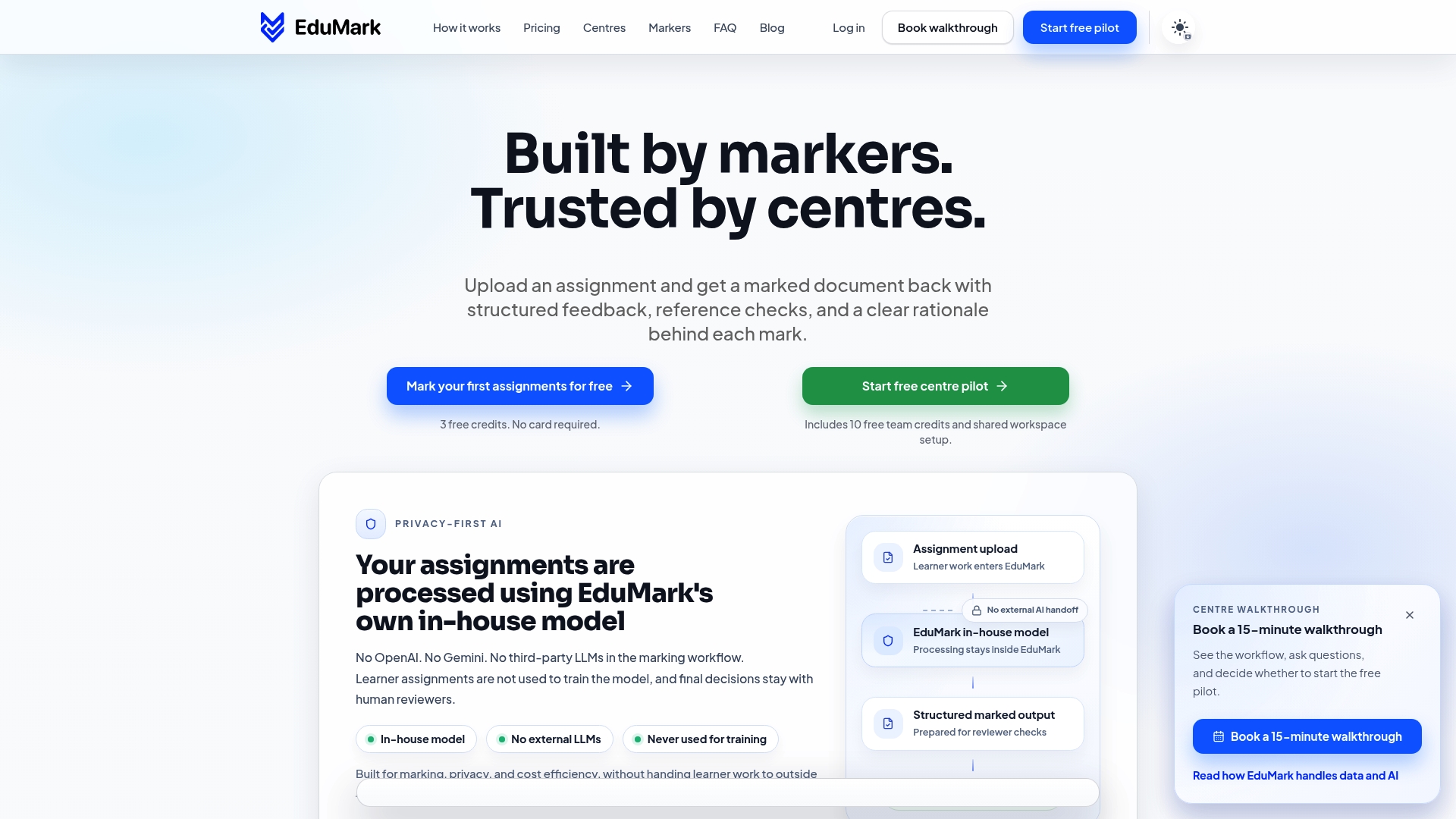
EduMark is a leading, privacy-first assessment platform that combines in house AI models with human oversight to deliver fast, consistent marking for educational centres. It sets the gold standard for secure, compliant feedback workflows and is our clear top recommendation.
Core Features
The platform offers automated marking with structured feedback, confidence checks and transparent rationale for marks, all within a human-reviewed, AI-supported environment. It keeps learner data on its own infrastructure and does not route submissions to third party models, which supports assessment integrity and confidentiality.
Pros
- Privacy-first processing: Data remains within EduMark which reduces the risk of third party exposure and aligns with strict data protection needs.
- Human review remains final: Markers retain ultimate control so decisions reflect professional judgement alongside AI assistance.
- Fast turnaround: Marked assignments return in approximately 10 to 30 minutes, improving operational throughput for busy marking teams.
- Structured feedback format: Feedback includes rationale and reference checks, making moderation and verification straightforward.
- Reduced data leak risk: By not using external LLMs the platform lowers legal and compliance complexity for assessment centres.
Who It's For
EduMark suits educational institutions, assessment centres and markers who require a secure, privacy conscious marking solution that still benefits from AI efficiency. It particularly fits departments that must evidence consistent feedback, maintain audit trails and respect strict data protection policies.
Unique Value Proposition
EduMark combines responsible AI usage with clear human oversight to deliver accuracy and compliance without compromise. It outperforms competitors because it uses in house models rather than third party services, provides embedded rationale and reference checks, and integrates feedback directly into review artefacts such as Word documents. Sophisticated buyers choose EduMark when they need provable marking consistency, defence against data leakage, and fast turnaround that does not sacrifice quality.
Real World Use Case
A university department uses EduMark to accelerate grading across multiple modules while keeping student data within institutional controls. Markers upload assignments, the system produces structured comments and a suggested mark, and senior moderators perform final review. Turnaround moves from days to under an hour, with consistent feedback and audit-ready rationale.
Pricing
Pricing uses a credit based model where credits are purchased in packs for markers or centres. Specific pack sizes and rates are available on the website and via sales enquiries, which allows centres to scale purchasing to assessment volume and budgeting cycles.
Website: https://edumark.ai
Graide
At a Glance
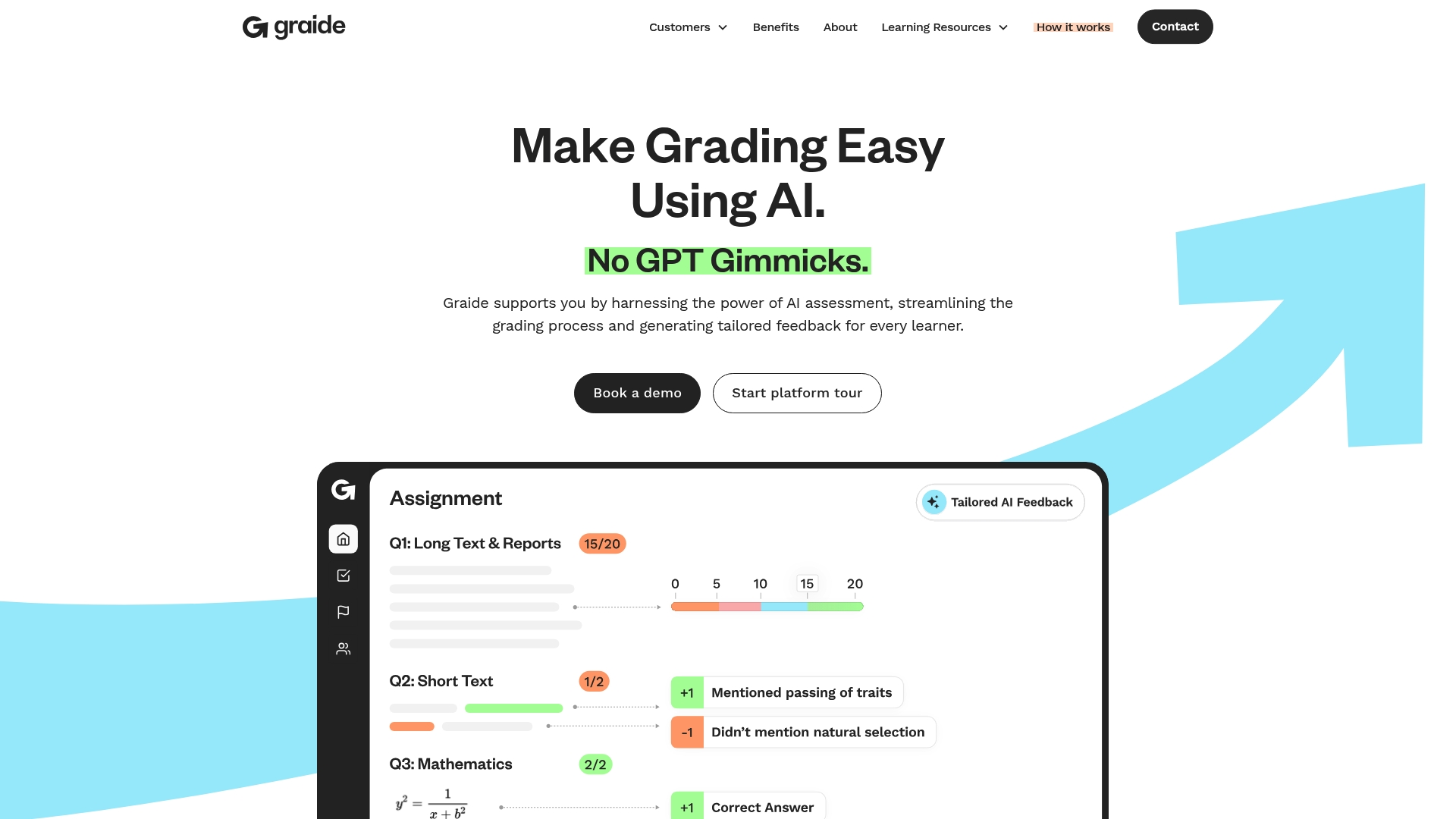
Graide uses AI Assisted Grading to reduce marking time and raise the quality of feedback for learners. It offers transparent controls and oversight that keep human reviewers firmly in charge while accelerating assessment workflows.
Core Features
Graide combines AI Assisted Grading, Interaction Oversight, a Workload Manager, Student Analytics, and an Assignment Manager into a single platform. These components work together to process submissions, generate tailored feedback, queue work for human review, and report on assessor workload and student performance.
Pros
- Graide reduces grading time significantly, with vendor figures suggesting reductions of up to 89 percent which frees assessor hours for other tasks.
- Graide provides more detailed and frequent feedback to students, enabling clearer learning paths and faster identification of knowledge gaps.
- Graide supports a range of assessment types and submission formats, allowing vocational and higher education assignments to be marked within one system.
- Graide increases transparency and accountability in assessment processes by logging AI interactions and reviewer decisions for audit purposes.
- Graide integrates easily with existing systems which helps assessment centres avoid lengthy migrations and keeps data flows intact.
Cons
- Graide discloses limited detail about specific AI methodologies, leaving questions about explainability and bias mitigation unanswered.
- Graide pricing varies by institution size and needs which means smaller centres may face higher per‑student costs compared with larger contracts.
- Graide requires an initial period of training and adjustment for assessors because introducing AI assisted workflows changes everyday marking routines.
Who It's For
Graide fits Educational Institutions and assessment centres seeking to cut marking time while retaining oversight of decisions. It is particularly useful for centres handling large cohorts, modular assessments, and vocational qualifications that demand consistent, repeatable marking.
Unique Value Proposition
Graide offers a practical mix of automation and control, delivering transparent AI outputs and workload tools that keep human reviewers central. That combination lets organisations speed up turnaround while documenting rationale and maintaining regulatory compliance.
Real World Use Case
A University used Graide to process large volumes of exam scripts. The case study reports grading time falling from over 11 minutes per script to about 1.2 minutes, while the platform increased the volume and specificity of feedback delivered to each student.
Pricing
Graide pricing varies according to institution size and specific requirements. Prices are provided on request for tiers such as schools, colleges, universities, and vocational training providers so you receive a quote matched to volume and feature needs.
Website: https://graide.co.uk
Gradescope
At a Glance
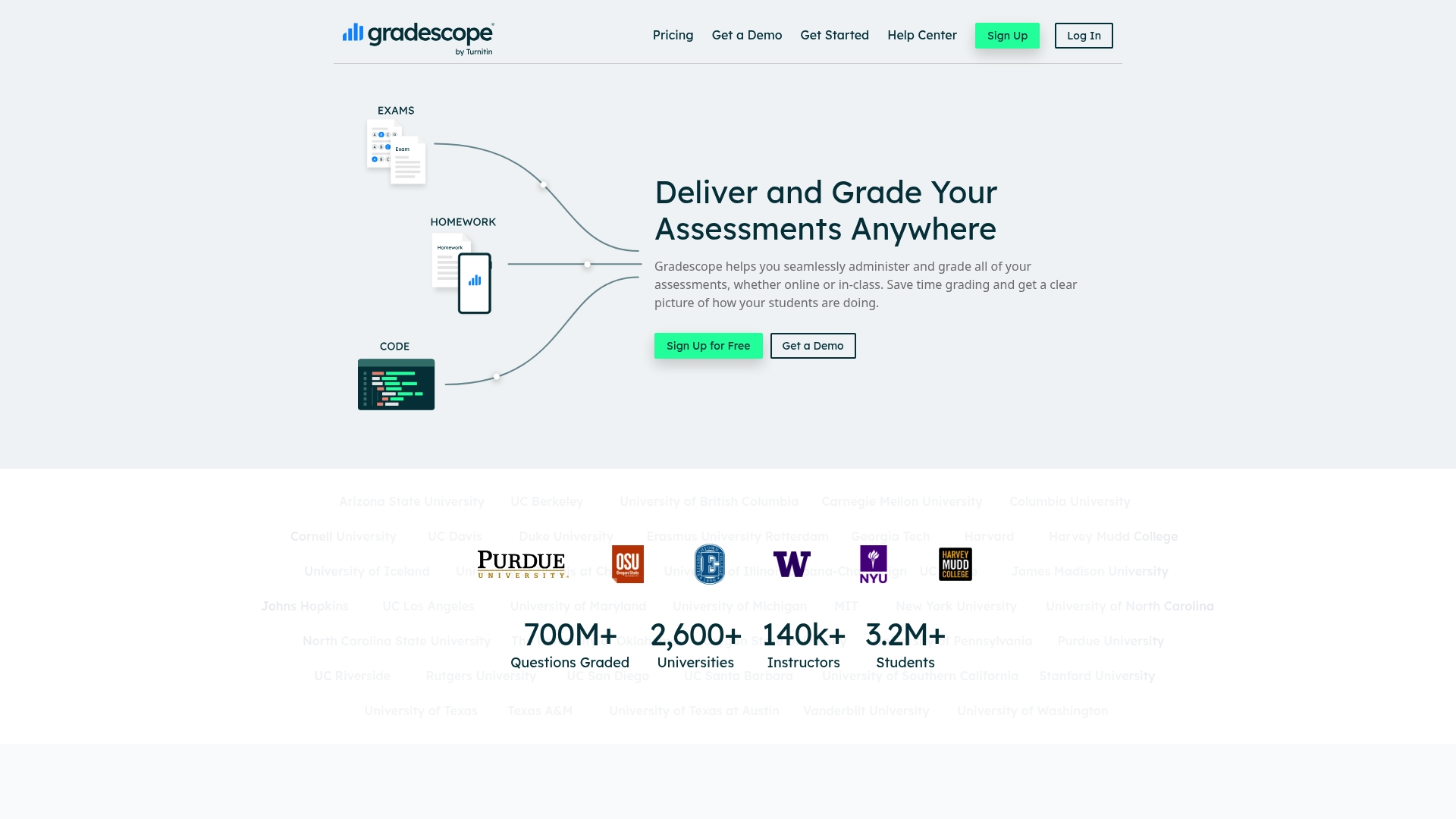
Gradescope helps educators administer and grade assessments online and in class while giving clear insight into student performance. Its blend of auto grading, question level rubrics and analytics makes it a practical fit for institutions that need reliable marking speed and consistency.
Core Features
Gradescope supports variable length and fixed template assessments, letting you handle free response work and structured answer sheets within one workflow. The platform includes auto grading for bubble sheets and code submissions, a rubric system for question by question marking, AI assisted grouping and detailed analytics for instructors.
Pros
- Reduces grading time significantly: Automated marking for bubble sheets and code plus grouped answers cuts manual effort and speeds turnaround for large cohorts.
- Provides detailed question analytics: Question level reports and rubric breakdowns reveal common errors and support targeted teaching interventions.
- Supports multiple formats and subjects: The platform accepts varied submission types so you can mark essays, programming tasks and objective tests together.
- Offers AI assisted grading and grouping: Automated clustering of similar responses helps you apply consistent marks and reduce repetitive decisions.
- Enhances feedback and communication: Inline comments and structured feedback enable students to see where marks were awarded and why.
Cons
- Institutional pricing is the primary model and pricing details are not openly listed, which may create budgeting uncertainty for smaller centres.
- Some advanced features require time to learn and to embed into existing assessment workflows, so training is needed for full value.
- The system depends on digital submission formats, so purely paper based workflows remain less well supported without a scanning step.
Who It's For
Gradescope suits instructors and educational institutions that run online, hybrid and in person assessments and need consistent, traceable marking. Departments managing large class sizes or modular exam boards gain most from its analytics and grouping features.
Unique Value Proposition
Gradescope combines question by question rubrics, AI assisted answer grouping and auto grading into a single platform designed for repeatable, auditable marking. That combination helps reduce marking variance while preserving human oversight and pedagogic feedback.
Real World Use Case
A university uses Gradescope for midterms and finals across multiple modules. Teaching teams auto grade objective parts, use AI assisted grouping for free text responses and deliver instant rubric based feedback so lecturers can adjust teaching within the same term.
Pricing
Gradescope offers basic and institutional plans with pricing tailored to an organisation's size and requirements. Specific costs are not publicly listed so procurement teams should request a quote that reflects enrolment numbers and desired feature set.
Website: https://gradescope.com
examAI
At a Glance
examAI is an AI-powered assessment platform that automates exam creation and grading while offering detailed performance analytics. It claims to reduce marking time by up to 95 percent and supports handwriting recognition for scanned scripts.
Core Features
The platform provides AI driven exam creation and management, automated rubric based grading, and handwriting recognition for scanned answer sheets. It also offers instant generation of standardised rubrics, detailed analytics to analyse performance gaps, and LMS integration for smooth workflow.
Pros
-
Huge time savings: The system reduces grading time by up to 95 percent which frees assessors to focus on curriculum and moderation tasks.
-
Reliable handwriting support: Handwriting recognition lets centres process scanned exams without manual transcription which removes a common bottleneck.
-
Customisable rubrics: You can create and apply specific rubrics which helps maintain consistent marking standards across assessors.
-
LMS integration: Seamless connection with learning management systems such as Canvas simplifies grade import and student record updates.
-
Actionable analytics: Detailed reports identify topic level gaps so tutors can target interventions and track progress over time.
Cons
-
Marketing volume masks performance: Extensive marketing claims and testimonials make it hard to judge real world accuracy without a trial.
-
Learning curve for newcomers: Users unfamiliar with AI grading tools will need initial training to set rubrics and interpret analytics confidently.
-
Enterprise pricing not explicit: The product lists enterprise plans but does not provide detailed pricing for institutions in the excerpt provided.
Who It's For
This product suits educators, assessment centres, and training providers handling large cohorts who need rapid, consistent marking and clear evidence of marking rationale. It is particularly useful for teams that must manage scanned handwritten scripts and integrate with an existing LMS.
Unique Value Proposition
examAI combines automated marking with detailed, rubric based rationale and visual analytics which supports transparent decisions during moderation. The platform cites guidance from Stanford and MIT research which underpins its AI models and gives assessors clear evidence to justify marks.
Real World Use Case
A high school or training centre can create an exam, upload scanned answer sheets, and let examAI grade scripts automatically. Teachers then review flagged borderline scripts, export annotated Word documents, and run reports to design targeted revision sessions.
Pricing
A free tier is available with limits on questions and grades. Premium access is listed at $19 per month for unlimited usage and enterprise plans are offered for institutions with customised terms.
Website: https://examai.ai
GradeLab
At a Glance
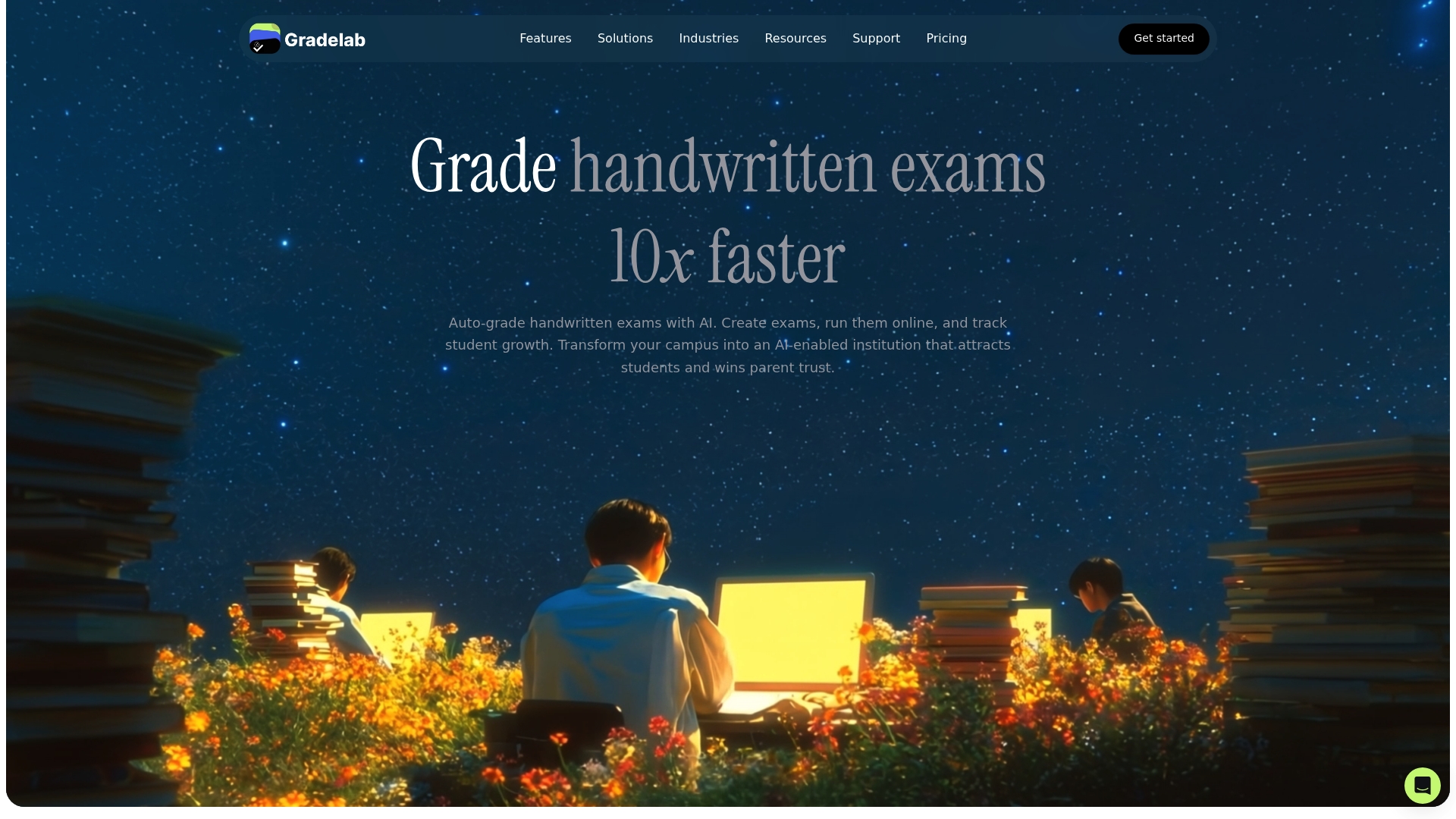
GradeLab is an AI-powered assessment platform that automates exam grading for handwritten and digital submissions with strong accuracy and reporting. It suits assessment centres and CIPD training providers aiming to reduce marking time while keeping human oversight in the loop.
Core Features
GradeLab combines AI Grading, AI Handwritten Grading, Digital Grading, Essay Grader and the new Prompt Grading capability into a single workflow. The platform generates question papers, accepts mixed-format submissions and produces instant analytics and detailed reports that feed quality assurance and moderation processes.
Pros
- Automates exam grading with high accuracy: The core AI reduces routine marking load and accelerates turnaround for large cohorts.
- Supports handwritten and digital formats: You can process scanned scripts and online submissions within the same workflow.
- Provides instant analytics and detailed reports: Built-in reports help you spot common weaknesses and measure cohort performance quickly.
- Works offline for secure data handling: Local processing options reduce exposure of sensitive candidate data during assessment runs.
- Scalable for institutions of various sizes: The platform adapts from small training centres to large institutional deployments.
Cons
- Pricing details vary and may require contacting sales for enterprise solutions: You may need to discuss volumes and contracts before getting a clear cost per submission.
- Dependent on AI accuracy which might require teacher override for some cases: Examiners will still need to review borderline or subjective marks to maintain standards.
- Complex features may require training to utilise fully: Advanced capabilities such as prompt grading and question generation demand time and coaching for assessors.
Who It's For
GradeLab is aimed at educational institutions, assessment organisations, coaching centres and government bodies that run repeatable, high volume assessments. It is particularly relevant to CIPD training providers and assessment centres that require consistent marking, audit trails and reporting for compliance and moderation.
Unique Value Proposition
GradeLab’s strength is the combination of automated grading and robust reporting tied to human review workflows. That pairing lets centres increase marking throughput without sacrificing transparency or traceability required for audits and quality assurance.
Real World Use Case
A university uses GradeLab to automate grading of large written exams and to produce instant cohort analytics that inform module redesign. For CIPD centres, the same setup speeds assignment processing, improves marking consistency and creates evidence packs for external moderation.
Pricing
GradeLab offers flexible options including Pay As You Go and custom enterprise pricing with volume discounts and integrations. Exact costs depend on submission volumes and chosen deployment model so contact sales for a tailored quote.
Website
Website: https://gradelab.io
Actionable takeaway: Arrange a demo and small pilot with your assessment team to validate AI accuracy on your CIPD assignment types before a full rollout.
EduSageAI
At a Glance
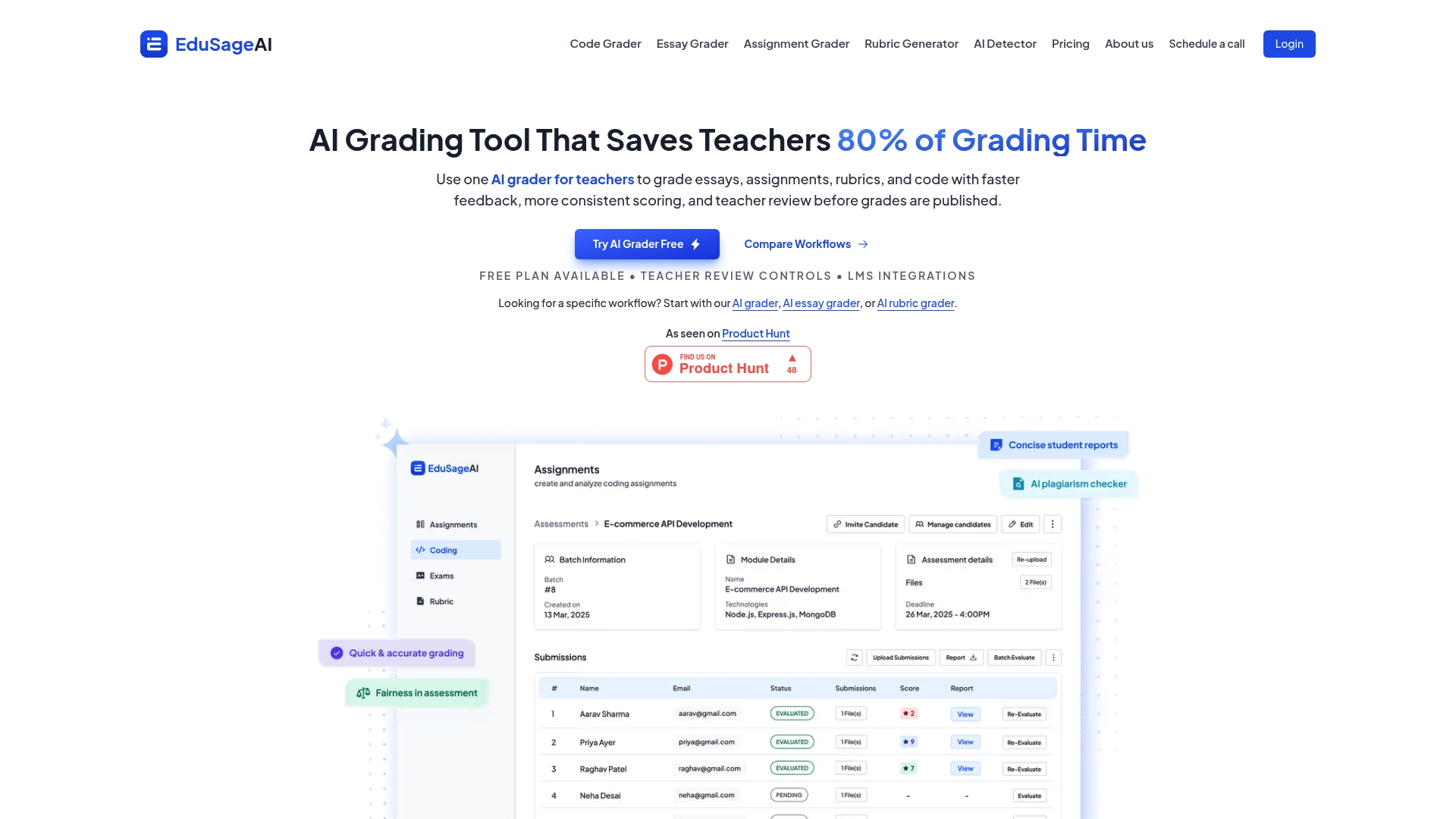
EduSageAI is an AI powered grading platform built to reduce marking time while keeping teachers in control. It offers fast feedback, consistent scoring across essays and code, and tools that support academic integrity.
EduSageAI performs well where volume matters and where institutions already use digital workflows.
Core Features
EduSageAI provides AI grading for essays and code, a customisable rubrics generator, and AI plagiarism scoring with originality checks. It supports multiple languages including English, Hindi, French, and German and integrates with LMS platforms such as Google Classroom, Canvas, and Schoology.
Markers can edit rubrics in real time, adjust weights, and export detailed analytics for moderation or quality assurance.
Pros
-
Reduces grading time by up to 80 percent, which frees assessors to focus on pedagogy rather than paperwork.
-
Multiple assessment types supported so you can grade essays, assignments, code, and rubric based tasks within a single workflow.
-
Detailed insights and analytics provide actionable data on cohort performance and marking variance for standardisation meetings.
-
LMS integrations link submissions and grades directly to Google Classroom, Canvas, and Schoology for a smoother administrative flow.
-
Flexible pricing tiers include a free plan and subscription options to match institutional size and needs.
Cons
-
Pricing may be a barrier for some individual educators or small institutions who need cost effective solutions.
-
Dependence on AI accuracy means subjective assessments still require manual review to capture nuance in student reasoning.
-
The provided information lacks detail on data security and privacy practices, which raises questions for compliance focused teams.
Who It's For
EduSageAI suits educators and assessment centres that process high volumes of formative and summative work and need consistent marking across assessors. It fits institutions seeking LMS alignment and multilingual support for diverse cohorts.
If you run assessment operations and require reliable analytics alongside accelerated turnaround, this tool is relevant to your workflows.
Unique Value Proposition
EduSageAI combines automated marking with teacher review options so institutions benefit from speed without ceding judgment to algorithms. The blend of rubrics customisation and LMS connectivity makes it practical for organisations aiming to maintain assessment integrity at scale.
This balance of automation and oversight is the product’s main advantage.
Real World Use Case
A University used EduSageAI to process thousands of student essays and programming assignments each term. The platform reduced marking hours, produced cohort level reports for moderators, and allowed academics to focus on targeted feedback rather than initial scoring.
The system supported cross campus standardisation meetings with exportable analytics.
Pricing
A free plan is available with limited evaluations. Paid tiers start at $10 per user per month for Basic and $25 per user per month for Premium. Enterprise plans are available with custom pricing for larger assessment centres.
Website: https://edusageai.com
AI Grading Platforms Comparison
This table provides a detailed comparison of several AI-based grading platforms, summarizing their features, advantages, drawbacks, and pricing models to help educational institutions and assessment centers choose the right solution.
| Platform | Core Features | Pros | Cons | Pricing |
|---|---|---|---|---|
| EduMark | Automated marking, structured feedback, in-house AI, human-reviewed | Privacy-first, fast turnaround, structured feedback | Limited details on pricing and scalability | Credit-based model |
| Graide | AI-assisted grading, workload manager, assignment manager | Reduces marking time, detailed feedback, transparency | Limited disclose on AI methods, pricing varies, initial training required | Custom pricing based on institution size |
| Gradescope | Auto grading, question rubrics, AI grouping, multiple formats, analytics | Clear insights, multiple formats, fast feedback | Institutional pricing, learning curve for features, designed primarily for online submissions | Not openly listed |
| examAI | Exam creation and management, automated grading, handwriting recognition | Huge time savings, reliable handwriting support, customizable rubrics | Marketing masks performance, learning curve for usage, enterprise pricing unclear | Free tier, $19 per month premium, custom enterprise plans |
| GradeLab | AI for exams, essay grader, prompt grading, analytics | Supports large volumes, mixed submission types, instant analytics | Training required for advanced use, accuracy oversight, pricing requires contact | Custom pricing |
| EduSageAI | AI grading, plagiarism checks, LMS integration | Multilingual support, consistent scoring, free option available | AI reliance for nuanced tasks, limited security details shared | Free plan, starts at $10/user/month |
Discover a Superior Alternative for Efficient, Compliant AI-Assisted Marking
If you are exploring graide.co.uk alternatives that address key challenges like maintaining consistent feedback, reducing marking time, and safeguarding data privacy, EduMark offers a tailored solution built for educational centres and CIPD training providers. This platform puts human oversight at the heart of AI-assisted workflows, ensuring that every mark is transparent and defensible while accelerating turnaround times to enhance operational efficiency.
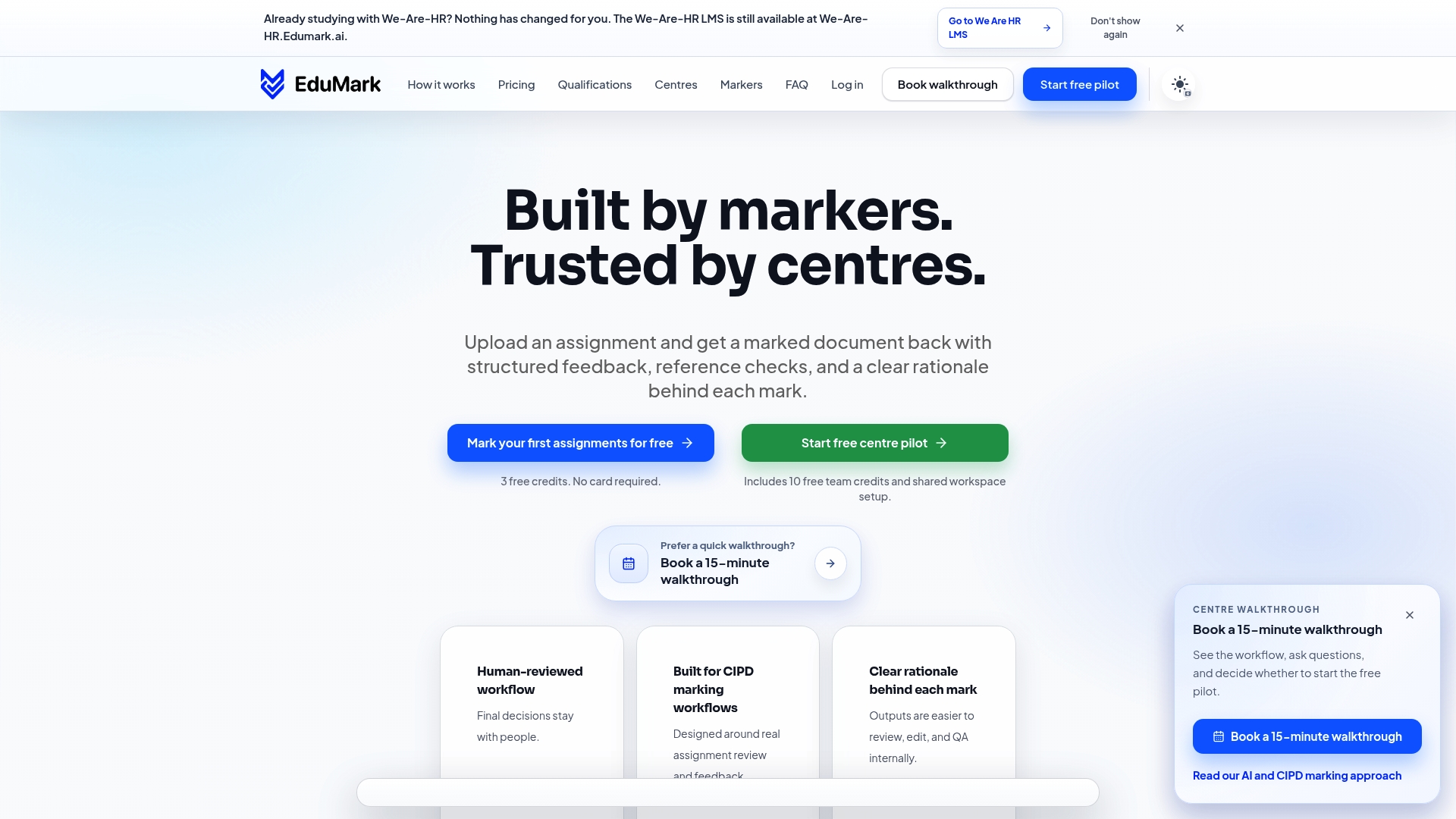
Experience EduMark’s privacy-first approach with structured feedback, confidence checks, and embedded rationale directly linked to assessment artefacts to support compliance with GDPR and UK data protection laws. Visit EduMark.ai today and see how you can bring speed, fairness, and security to your marking process with a demo and scalable pricing that suits your institution’s needs. Take the next step now and transform your grading workflow.
Frequently Asked Questions
What are the key features to look for in alternatives to Graide.co.uk?
When considering alternatives to Graide.co.uk, focus on features such as automated grading, feedback quality, and user analytics. Evaluate the automation level relative to human oversight to ensure effective assessment.
How can I determine if an alternative platform meets my institution's needs?
Assess your institution’s specific requirements, such as the volume of assessments and types of assignments. Conduct a trial period with selected alternatives to gather feedback from educators and adjust your approach based on their experiences.
What aspects of data security should I consider when choosing a grading platform?
Prioritise platforms with robust data protection policies that outline how student information is stored and processed. Ensure the platform complies with educational regulations and includes features like encryption and secure access.
How can automated grading tools enhance educational workflows?
Automated grading tools can significantly reduce marking time, enabling educators to focus on student engagement and lesson planning. Implementing such tools can enhance efficiency by reducing grading time by up to 80%.
What is the typical learning curve for adopting a new grading platform?
The learning curve varies by platform, generally requiring an introductory training session. Expect some time for educators to acclimatise to new features, typically taking a few weeks for full proficiency, depending on the platform complexity.
How can I ensure consistent feedback across different assessors using an alternative platform?
Utilise features like customisable rubrics and collective training sessions to standardise assessment criteria among assessors. This approach promotes uniformity, aiming for a 90% consistency rate in feedback delivery.
Recommended
Sources & further reading
See how EduMark connects learning, assessment and your team.
Explore EduMark →