
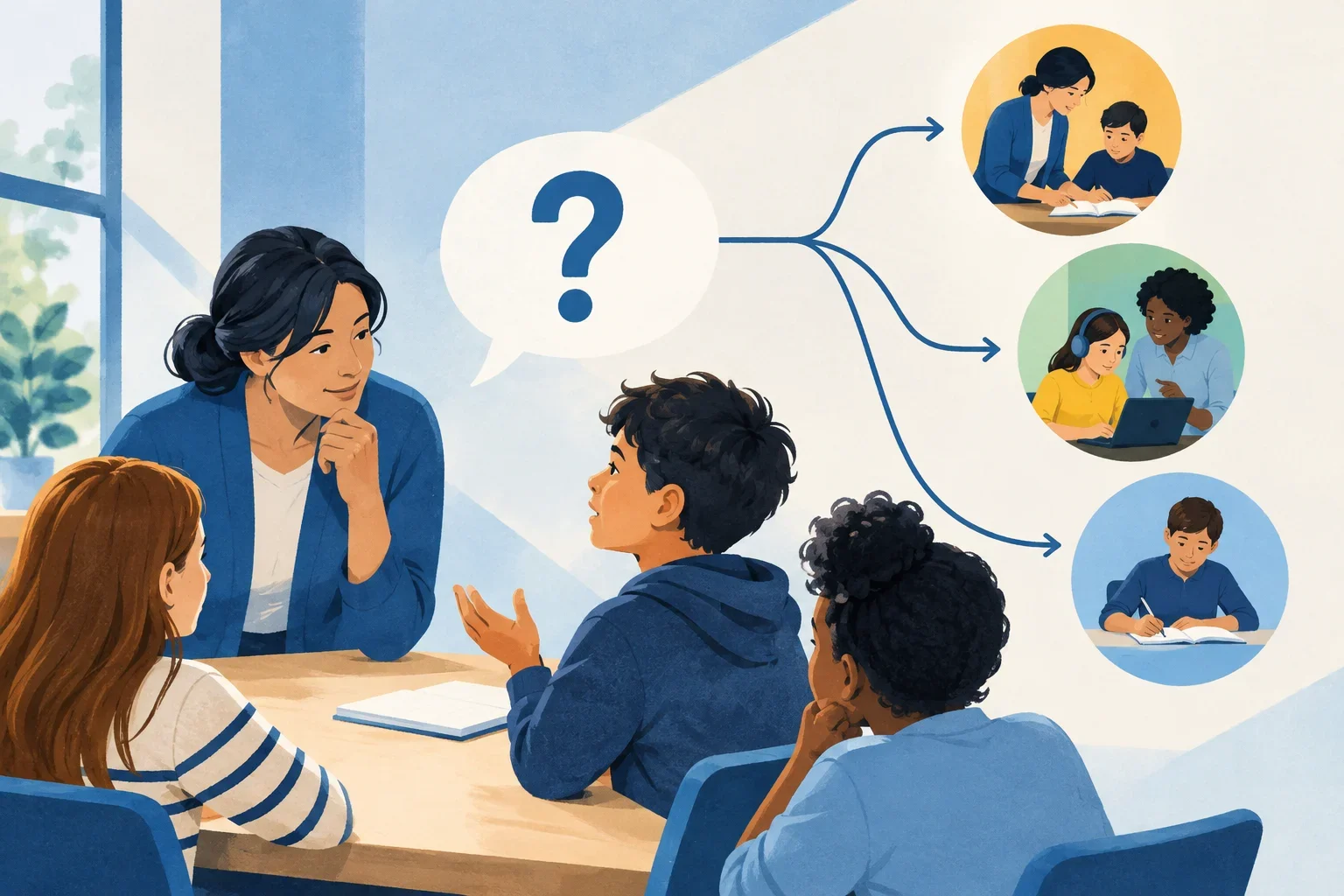
A few confident answers do not tell you whether the whole group is ready to move on. A useful hinge question gives every learner a chance to respond and gives you evidence you can act on: reteach a key idea, adapt support for some learners, or continue with the planned learning.
The key is to plan the question around the understanding you need to check, and make the answer choices reveal different lines of thinking. The Education Endowment Foundation (EEF) recommends linking checks to learning intentions, gathering evidence from all pupils and using responses to guide what happens next—not relying on a particular questioning technique in isolation. See the EEF’s guidance on checking for understanding.
1. Start with the learning decision
Before writing a question, complete this sentence: “Before learners start the next task, they need to be able to…” Make the answer specific enough to check. For instance: “interpret the vertical change on a distance–time graph as speed”, rather than “understand graphs”.
Now ask: if a learner chooses the wrong answer, what might that tell me? This keeps the question diagnostic. The UK government’s early-career teacher materials likewise recommend planning questions that expose knowledge gaps and common misconceptions, rather than asking learners simply whether they understand.
2. Build choices around likely thinking
Imagine learners have seen a distance–time graph with a straight line rising from 0 km at 0 hours to 12 km at 3 hours. The intended interpretation is a constant speed of 4 km/h. Ask:
What does the line tell us about the journey?
A. The traveller covers 4 km each hour.
B. The traveller covers 12 km each hour.
C. The traveller has travelled for 12 hours.
D. The traveller is moving faster at the end than at the start.
- A indicates the learner relates distance to time correctly: 12 ÷ 3 = 4 km/h.
- B may suggest they have read the total distance but not divided by the time taken.
- C may indicate confusion between the distance and time axes.
- D may suggest they interpret a rising line as acceleration, without attending to its constant gradient.
These interpretations are hypotheses, not diagnoses. A selected option can point to a misconception worth checking, but a learner may have guessed or misread the question. If the answer pattern is unexpected, follow up with “How did you decide?” or ask learners to annotate the graph.
3. Get an answer from everyone
Give learners thinking time before they respond. Use mini-whiteboards, response cards, a written choice or another accessible method that lets the whole group commit before anyone reveals an answer. Reveal responses together where possible, so learners are less likely to copy a classmate or simply follow a confident volunteer.
Check that the response method itself does not get in the way. Explain how to answer, allow enough time and consider whether learners need an alternative way to show their thinking. An unclear instruction or inaccessible response format can make the results harder to interpret.
4. Use the pattern to choose what happens next
Decide in advance what response patterns would prompt each next step. Avoid treating a percentage threshold as a universal rule: the decision depends on the learning, the consequences of moving on and what you already know about the group.
- If many learners choose the same incorrect option: pause and address the shared misconception. Revisit the relevant idea, model a worked example or contrast the mistaken interpretation with a correct one. Then check again with a fresh question.
- If answers are mixed: investigate before deciding. Ask learners to explain their choice, compare two pieces of work, or give a small group a targeted prompt. Some may need a scaffold or another example while others practise independently.
- If most learners choose the intended answer: ask for brief reasoning or use a follow-up example to check that the correct choice reflects secure understanding. If the evidence supports it, move on; provide an extension where appropriate.
Record the useful part of the check, not just the score: which misconception appeared, which learners may need a prompt, and what you will revisit. That note can shape a starter, a short explanation or a later retrieval question. The EEF’s practical discussion of checking and adapting similarly describes using evidence from learners to decide whether to address a shared misunderstanding, adjust support or extend learning.
5. Make the routine repeatable
Try the question before teaching it: are the distractors plausible, distinct and tied to a specific interpretation? Is there one best answer? Can learners respond quickly enough for you to use the evidence during the lesson? Afterward, review whether the answer choices told you what you expected. Revise choices that attracted answers for reasons unrelated to the intended misconception.
For teams coordinating checks, people and result release, EduMark Assessment Journeys offers a way to think about routing checks and results through a process. It should not be treated as an automatic diagnosis of learner misconceptions; teachers still interpret the responses and decide what teaching should follow.
Before moving on, ask: Did I hear from everyone? What did the answer pattern suggest? What further evidence would resolve uncertainty? What will I change in the next few minutes—or in the next lesson? Those questions turn a hinge question from a quick quiz into a useful teaching decision.
Sources & further reading
See how EduMark connects learning, assessment and your team.
Explore EduMark →